Monday, 24 June 2019

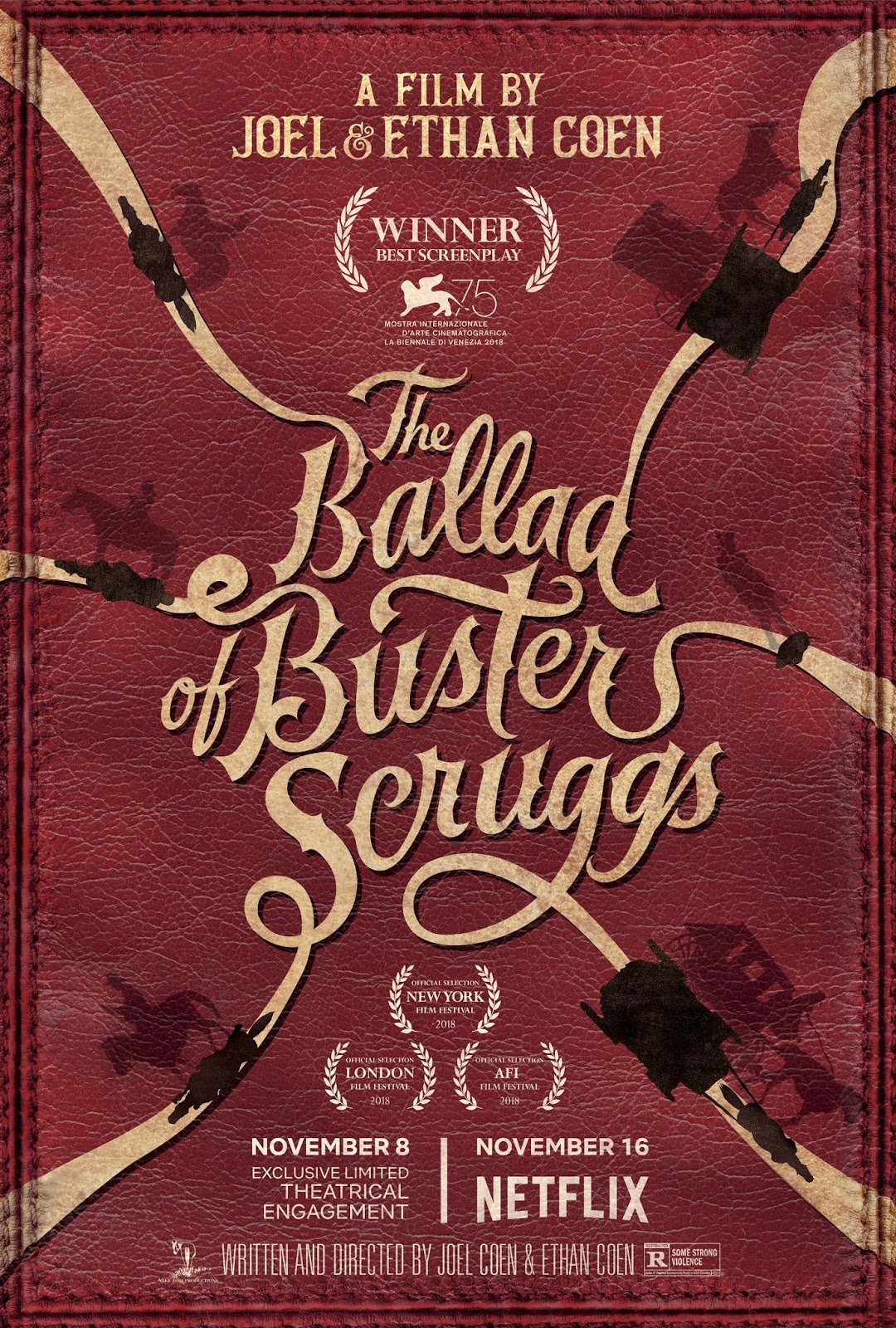
The ballad of Buster Scruggs - a review

Six stories –all taking place in the ol’ West. Six stories that are morbid to a fault. Six stories that’ll make you laugh, wonder, and feel miserable. Six bullets to a revolver...

Now this is my kind of silly! The ballad of Buster Scruggs is a dark (a bit too dark at times) collection of stories that skilfully manoeuvres between heart-wrenching and hilarity. The best way one could describe this anthology tale is like an ‘updated version of Tales from the Crypt’.

But, where, in the early nineties all the characters in those macabre tales should be unlikable just so the audience wouldn’t mind their inevitable demise much; nowadays times sure have changed.

After movies like Se7en (1995), Fight club (1999), even the Coen’s brothers very own Fargo (1996) and True Grit (2010), audiences have warmed up to the notion of a ‘reasonably good guy’ getting the short end of the stick in drama.

‘Good-guys failing’ is no longer solely reserved for the horror and war genre.
In contemporary drama it is, nowadays, rather common for ‘our’ hero to find him-/herself
in a bigger pickle at the end than when the movie started.

And this is what the Coen brothers use for maximum effect in The ballad of Buster Scruggs. Which, unfortunately is also the biggest critique reviewers can give this movie: ‘We might know that evil triumphing over good is commonplace nowadays but can’t you please give use something? Anything?’
The answer by the Coen brothers is a blunt: ‘No!’

Intermezzo: The hurt factor.
The difference between comedy and melodrama is the ‘amount it hurts’.
Imagine a scene in which a guy is walking down the street and a flowerpot falls on his head (Yes, it’s an old Donald Duck cartoon –and (yes) it serves my purpose). In a melodrama his skull would crack -blood spurting out; he would die on the spot. Then, to ‘use this momentum’ the lover of this poor man would run towards his body and cry her hearth out. In short this scene would probably last for, at least, five minutes.

The same scene: a flowerpot falls and lands on a guy’s head. He is dumbstruck for a moment and, during that time, accidentally pulls a police-officer’s pants down. The officer gets angry and chases the man down the streets.
Now the focus is quickly directed to the pants-less officer, not the ‘horrific event’ that just occurred to the poor protagonist.

Less drama, less ‘hurt’, is the difference between  melodrama and comedy, and it is the oldest trick in the book!

More recently Shazam (2019) used this exact same trick on a smaller scale. Here the protagonist meets a handicapped boy. But the boy in question is a loudmouthed joker. He hates his handicap, obviously, but he’d be damned if he is bothered by it. So the boy cracks jokes about his handicap.
By dismissing the (obvious) handicap in a comedic manner the moviemakers are allowed to push some (melo)drama to the boy on another level. In the case of Shazam: The boy doesn’t have any friends.

We, the audience, realize that his handicap (and maybe his way of coping: his loud mouth) might have something to do with it in the backs of our mind. But these possible reasons become background noise to the ‘current’ melodramatic aspect.

In short: you can have a character go through all kinds of (mortal) ordeals and let him brush it off. But when you allow the camera to stay with the event, when you focus, the (melo) drama creeps in.
That’s how you write a (comedy) movie. And that is exactly what the Coen brothers do ‘per excellence’ in The ballad of Buster Scruggs.


Six stories
There as six stories being told in The ballad of Buster Scruggs. And, even though the stories don’t overlap in characters, they do overlap in thematic.
Just to give you a short summary of the stories:

The Ballad of Buster Scruggs
Buster Scruggs is a singing gunslinger who is too perfect for the world he is in. And maybe he’s right.

Near Algodones
A nameless bank robber finds luck and desolation a he ‘pulls the job of a lifetime’.

Meal Ticket
A handicapped entertainer finds his art in danger because the ‘real’ world is creeping in.

It took me a while to recognize the actor – but eyes always stay the same.

All Gold Canyon
A gold-digger finds his gold in the most beautiful of places. Only when he is gone will beauty return –one way or another.

The Gal Who Got Rattled
A woman is on her way to Oregon. But the dog keeps chasing her and she doesn’t have the heart to stop the animal.

The Mortal Remains
Five people on a coach. Destination: the same end.

Each of these stories is as solid as they can be. The ‘hook’ of each story can be surmised in a single sentence. The plot itself might take two more, but not much. The basic ‘tree’ of each story of this movie is simplicity itself. Now it is up to the scriptwriter and the director(s) to but some branches/meat on this tree-or: skeleton.
And this is where, usually, the problems happen.

No perfection Nevada
When writing, direction, or even editing a movie, you are in danger of ‘bloating’ said movie.
Any movie is a story from A to Z. The style or words might be different but still the basis remains. If it is Bollywood, Hollywood or Nollywood movie: each movie, ever made, has a beginning and an end.

It’s the time in-between that’s important.

A movie can spent too much time on things that don’t matter for the (A to Z) story.
One of my favourite ‘bad movies’, for instance, (Haemoglobin -1997) has a pretty long sex-scene that has no purpose whatsoever except for the reconfirmation that the two main characters love each other. The same gist I got five minutes before in the single line of dialogue that said: ‘I love you!’.

So that sex scene was only ‘thrown in’ to please the audience on ‘another level’.

So a movie should be constructed as such that there aren’t a lot of unnecessary scenes (or long scenes) muddling up the main (A to Z) road.

Unfortunately The ballad of Buster Scruggs (like many other movies before and after) fails to do so. But why? This has everything to do with the story the movie is telling at the time in context to the ‘whole’ of the movie.

Too long, but why?
Two of the stories in The ballad of Buster Scruggs tend to overstay its welcome: Meal Ticket and The Gal Who Got Rattled. Both stories are both a bit too long to keep the audience (me) interest/‘invested’. This mainly has to do with the placement of the two episodes in whole of the movie.

By the time these stories appear we’ve already sat through two pretty dark tales so we know that chances are quite high that the next story won’t end happily ever after either.

Keep in mind that the prints shown before each story are a bit of a spoiler.

So a viewer dilemma occurs. On the one hand you want (for example) a ‘love story’, or, a ‘road to riches story’ to reach its end successfully, yet, on the other you know ‘darn well’ that that’s not likely to happen

Knowing what kind of movie you are in prevents said movie to play certain trump cards on you. Each scene needed for the fictional tale of two people falling in love ‘feel unnecessary by context’ because you/the viewer knows that things won’t work out anyway. So why bother?


A great movie might manage to make the audience forget about ‘what kind of movie they are watching’, But, even though The ballad of Buster Scruggs tries (All Gold Canyon) it simply doesn’t manage to play with its audience as it set out to do.

Fixing the fault
A simple fix would be to place either of those two stories at the beginning of the tale. But apart from not being able to call this movie The ballad of Buster Scruggs no-more, one should also realize that neither The meal ticket or The Gal Who Got Rattled are show-openers!
As any entertainer knows you need something mesmerizing to open a show with. And, in The ballad of Buster Scruggs, a singing cowboy might just have to do.

Mentally re-cutting The ballad of Buster Scruggs I would’ve cut-up The meal ticket-story
 and used each of the artist’s speeches (watch the movie, you’ll know what I mean) as an interlude to each new tale.
Then, as a final scene I would end the tale as it ended in ‘our current version’.
Leaving the cinema-audience bleak, dark and (above all) shocked.

Still a (gun) blast
Having that said the dialogue is wonderfully written throughout this anthology. Especially noteworthy is the dialogue in The Gal Who Got Rattled. Each scene of her talking to her (possible) lover oozes of innuendo.

Did her brother die from dysentery? I really want to know!
I would be a shame if he didn’t – I’m just talking for the ‘Gamer generation’ here.

But, this being a script movie first (as all the Coen brothers movies basically are) every scene is deliciously written and, above all, deliciously acted. The mad banker (played by a wonderful Stephen Root) in Near Algodones could’ve said the words any kind of way but it was decided to use this particular style.
The same goes for the ‘trapper’ (Chelcie Ross) in The Mortal Remains who has a wonderful, awe-inspiring, monologue that just won’t end.
Just two actors delivering lines. But where the first actor used pitch of voice the second actor mainly used tempo to deliver his lines.
Regardless: still the lines remain.

Combining this with wonderfull shots of the western landscape and you’ve got yourself quite the mesmerizing piece of filmic fiction.

Still, in the end, The ballad of Buster Scruggs might be a bit too bleak in its message to win over anybody else but the Coen-enthusiasts. A shame really. But not something I’m particularly worried about. The brothers have found their own style of storytelling ages ago and are going with it. The movies they make might not appeal to the general audience but are great, well made, movies all the same.

A perfect murder – a review: or how one's personal life influences enjoyment.

A wife is having an affair. Her husband finds out and wants to kill her for that (and the large inheritance of course). But how does one murder one’s wife – perfectly that is?

I like (almost love) the 1998 movie: a perfect murder. But the reason why is rather more subjective then, let’s say professional. Let’s just count my life down:

Childhood.
My mother is a bed-time storyteller ‘per default’. But even she –with her unlimited supply of fairytales- was, at certain moments in time, at her wits end. So she decided to tell me ‘crime stories’ instead. Especially those stories told by Agatha Christie and Alfred Hitchcock. Me, being six at the time (when does story-time truly end one might ask?) loved it. Particularly the ones in which a criminal gets caught by a simple mistake even six-year-old me could understand.

keep in mind that I was –at the time- desperately trying to steal candy from the candy jar without being caught.
My mother was unbeknownst giving me advice.

Preteen.
I saw Dial ‘M’ for murder (1954) for the first time. I loved every second of it. I loved Grace Kelly for reasons I didn’t fully understand yet. And I loathed Ray Millard because he was so coy about the fact that he was trying to kill his wife.
I also enjoyed seeing  Anthony Dawson as the poor smuck set up to be the by-proxy killer. This is the same guy who got himself killed by James Bond in Dr. No (1962). This actor will always be known as the ‘second in command’. I pity him for that; but then again, ‘we’ (the public) will also always love him for that!

What I especially enjoyed at this young age is the amount of planning that goes into committing a perfect crime. A trick that works just as well for planning your homework.

Teenager.
When I was a teenager I won a prize: one year of free movie tickets (two tickets a month). Since I didn’t have anyone to go with me at the time I saw a lot of movies. One of them being a remake of my, personal favourite movie: Dial ‘M’ for murder this time called: A perfect murder (which is, by the way, a ‘perfect’ title).
At the time, I was shocked! This movie was far too American (and overacted).

And this was long before I saw the Christopher Plummer's version (1981). I only saw that (brave attempt of a) movie recently.

Here we have Michael Douglas playing the darker version of Gordon Gekko. Gwyneth Paltrow balancing her way between a coy anti-feminist house-wife and a strong independent woman. And the whole threat for the woman facing a possible death-sentence for a crime she didn’t commit was left way out the door. But most of all; the shock of seeing David Suchet (Mr. Hercule Poirot himself) as a clueless detective broke the movie for me.

At the time I didn’t like the movie much. I enjoyed the fact that Hollywood dared to try another version of a ‘perfect movie’ (more about ‘prefect’ later). But since I didn't like it I moved on.

As I grew up.
As I grew up I started to reject this movie more and more. For the various reasons I’ve hinted at (above). I didn’t see if for at least ten years.
It took time, for me, to accept the fact that A perfect murder isn't a very 'perfect’ movie. But it would be rather dismissive of me to call it a ‘bad’ movie. Or even a ‘bad’ remake for that matter.

Growing older.
It was only when I ‘proudly’ wore the old T-shirt of this movie (another contest I won back then –true story) in a factory-cleaning-job ,that I started to realize the work that’s involved ‘making’ this movie. It all has to do with the simple brilliant poster that featured prominently on my T-shirt. Each time I took the T-shirt out of the wash to get to work I was reminded of the movie. And one day I rewatched it.

The way Michael Douglas posed on the poster (and my T-shirt): brilliant!

Daring the crime.
It is a pretty brave thing to remake a classic. And by the time A perfect murder was made Dial ‘M’ for murder was considered a classic. It was pretty much up there with Psycho (1960) and Vertigo (1958). Not in the ‘top 3’. But important nonetheless!

The original Dial ‘M’ for murder,though, isn’t one of the great ‘Hitchcock-ian’ movies. It’s pretty much a stage play caught on screen (much like Rope [1948] – but with a lot less tricks-up-the-sleeve). The main gimmick of this movie was the 3D-aspect (whatever James Cameron tells you; the technology isn’t that ‘new’). So there is a wonderful shot in this movie which involves (the great) Grace Kelly reaching ‘into the audience’ for her scissors.
The rest of the movie, however, is rather coy. Just people talking.

Hitchcock probably liked the idea of 3D, but he certainly wasn’t going to let it get into the way of good storytelling.
And that’s what Dial ‘M’ for murder really is; It’s a small –stage play- story with some beneficial 3D effects in the tension scenes. But most of all it is a solid tale about a man wanting to murder his wife.

Hitchcock, in this sense, transpired the ‘gimmick of the age’ by giving the movie an unbreakable story that could still work without all the ‘mumbo jumbo’ (of 3D).

So, to be honest, the original wasn't that untouchable to begin with. As long as the remake didn’t hurt the core story too much it would be fine. In this sense the challenge the producers posed to the remaking moviemakers was a simple: “remake Dial ‘M’ for murder. This time without the 3D shenanigans!”

This challenge would’ve been easy, if not for the additional requirement: “make it contemporary!”.
The question of whoever made this choice will never be answered. But one thing is perfectly clear: the choice of the era made all the difference.

Can we make a perfect murder: today?
So now you –the movie maker- are posed with a challenge. What to do? What is the budget? How far can we take this story?
Budget-wise the first choice was made rather easily: since he move would be contemporary the looming death-sentence would be scripted out.

Second; contemporary, means upping the characters. The wife has become more active and (incidentally) so does the husband.
So the wife has to perform an investigation of her own (and destroy he husband along the way). And the husband actually has to kill somebody!

It’s the late 90s we’re talking about. A new ‘view’ on matters as it were. Which also means turning the tables and making the wife’s secret lover the murder-by-proxy.

Getting Old.
Once you realize this, pieces fall into place. The original movie was perfect for its time. The later movie was perfect for ITS time. And, honestly, one shouldn’t compare the two!
So, as I became older I started to enjoy A perfect movie on its own merrit. Meaning: without the baggage of its predecessor, and in this context of the era the movie works like a charm.

The way Gwyneth Palrow uses the gun in the final scene is logical (right for the time) in every sense. The way Michael Douglas’s character bends the truth throughout the movie is flawless and very probable for a ‘high functioning sociopath’ as most bankers are (remember my comment about Gordon Gekko).
For a 1998 movie A perfect murder is quite good! It is the ultimate movie of the year because this is exactly what we wanted back then. But, alas, it got dragged down by its (superior) predecessor.

Wednesday, 22 May 2019

Game of Thrones season 8 – a review

We are at the endgame now. We’ve got numerous major characters and two major battles to fight; one against the undead and one against the mad-queen. Not everyone is going to survive ‘till the end; this much we know, it’s Game of Thrones after all.

As the series is reaching its end this season also has half the episodes it used to have. Less episodes means a bigger budget one could surmise from a meta-perspective. But, from a narrative perspective one should also acknowledge that most of the storylines of the major characters are done. Theon has, pretty much, reformed himself. Arya and Sansa have found each other again. Sansa is (finally) the dark queen we wanted her to be. And Bran, well, I don’t really know about him yet.

I’m writing this post as a sort of diary as I watch the show weekly.

First things, first
In good Game of Thrones fashion the first episode is all about advancing some character-plots forwards. Not too much, just enough to get the chess pieces in place.
This time ‘round, however, there is an urgency behind it all (in the form of an undead army coming to visit Winterfell). So the episode quickly addresses the matters that are left on the table like some people getting reacquainted (Arya and Jon) or Jon’s heritage- a question that is tackled with suitable attire (I love Sam and Gilly deeply).

From the first episode on there is a build-up to episode three, aptly called: ‘The long night’. All those side-remarks from old Nan in the past are now coming true. -As is visually depicted by that tableaux the Night King left at Last Hearth for Tormund and troupe to find. But still there’s an episode to go before we get to this first big battle of two.

The calm before the storm
The second episode felt a bit like the penultimate episode of Lost: A very separate (‘bottle’) episode to what we’ve known. As this episode focuses all its attention on characters and their motivations for aligning themselves on the ‘living side’.

This episode is a goodbye to the characters. Like a well-made World War I movie likes to invest in characters for one last time before they go over the ledge. After this episode there truly is a feeling that all has been said that should’ve been said. Now there’s only battle left.
This  makes this episode the last episode to have characters fix the final strands of storyline lingering; like Arya’s list, or Jamie’s honour.

On a side-note: The Arya sex scene. Can I just say that I enjoyed the shock that went through the internet when we all found out that the actress has become a grown woman. This always happens when a (former) child actress does a lewd scene as they've grow up (Natalie Portman in Black Swan, anybody?). Please don’t ever change; online-people! I think it is healthy to be a bit shocked about this.

Let’s start the fight
And there it is! The first big fight! The one massive ‘kill-your-darlings’ showdown the show has been teasing since the very first shot of the very first episode.
The battle of Winterfell is the dark half of the Battle of the Bastard. Apart from the shift between day and night;I mean that where Ramsay Bolton was clearly insane he also had some warped feelings about justice. The Nightking, however, has no feelings. The night king is pure apathy who only seem to enjoy smirking when he cheats (by raising a new dead army).

The biggest critique I have about this episode (apart from the Deuce-Ex-Arya and the lighting) is probably the lack of budget. No money in the world could’ve made this episode live up to (my) the expectations the show built towards it.

Even though this episode showed what a good storyteller can do with a constrained budget (the Dothraki lights-scene was a stroke of brilliance).
Whilst, at the same time, it has to tell a story of a limited number of men against an unlimited supply of enemy; and the episode wasn't afraid to show the world the way World War Z should've been.

Still, calming down from my initial (irrational) disappointment, it is amazingly good episode. The episode obviously didn’t do what I wanted it to do

like Bran warging into the ice-dragon or Lady Mormont doing some kick-ass battle (or simply glaring a ice-zombie to death).
I guess a zombie giant has to do.

of course it doesn’t –and I don’t want it to; ‘surprise me’. And surprise me this episode did! Whilst, at the same time, using a clever narrative/visual structure of  the Halloween-(horror-movie)-spacing technique.

Meaning: you start out grand in wide open spaces and as the tension grows and things become more dire for the characters you care about you make those spaces they inhabit smaller. This same 'trick' was more recently used in Jurassic World: Fallen Kingdom.

That with the Game of Thrones technique of adding ‘little’ mini-battles within the grand siege makes the episode quite enthralling. As is Game of Thrones (or any anthology series) this episode lets you skip from one character to the next so you don’t bother if you are stuck for a minute or two with a character you don’t like.

At the same time a good fight for honour and valour can make the most unlikable, weak, character (=Theon) earn his way back into your respect. In fact, now that he’s gone I actually miss his storyline even if it included an entire season of torture.

One choice that did cloud the episode a bit was the chaos near the end. This a definite choice made by the showmakers; basically telling the audience: “The plan is shoot everybody is now out for survival.”

Chaos, however, doesn’t make enthralling visual storytelling because the final goal is gone. It works of course on a character level but in visuals the ‘time spent in chaos’ should be kept at a minimum. Subplots should be introduced (like Jon reclaiming his Valerian sword) that lead up to the final goal.

In the battle for Winterfell these little subplots were only glanced over at the end and the main focus stayed on the survival of the characters. Which bloated the episode a bit with unnecessities.

Licking our wounds
The next episode, then, is yet another build-up to the next battle. The armies of the living (good) have diminished quite considerably. Yet, the army of the evil queen is strong as ever. What’s more, there is a slow growing feud between aunt and nephew on who will sit on the iron throne when all is said and done.

It is, however, a good time to turn another leaf. As I said above most of the lingering story strands have been solved in episode two; so now it is time to focus on some of the consequences in combination with the survival of the characters. And this is exactly what this episode does.

Let me talk a bit about ‘houses’. By now, most of the houses of Westeros are dead:
The Bolton’s, the Mormont’s, the Frey’s, the Baratheon’s (apart from a bastard son), the Tyrell’s.
 The ‘united nations’ has never been so bloody.

This, episode is, therefore the perfect moment to re-introduce the storyline of Bronn –the man without a ‘house’ (and without honour, as he said it –though we all know he has: he honours a good person; in this sense he’s like an ‘angel’-character).

Like Cersei, Bronn is underplayed this season. But when he gets his moment to shine he does. And with his sudden appearance the lays out the theme of the episode: ‘You might have won for the side of good. But the Game of Thrones is still being played and getting bloodier by the minute. How bloody are you willing to get?’

Hells bells and buckets of blood
After the long night comes the shimmer of summer. New lines are drawn in the sand for the final stretch. People who used to be good turn unhinged. People who used to be smart make foolish choices. And people who used to be merciless become kind.

Like the later episodes of every completed television show it is in the final stretch that some characters have to be ‘gotten rid off’ rather quickly and thus without a lot of pump and circumstance. That is why Varys made the ill-gotten move of openly discussing his idea for treason to Tyrion. And for that same reason it was Melisandre who (from a sea of people) managed to get herself caught –and recognized for who she was- by the pirate king.

Like the famous submarine-episode in Lost this method of clearing the board is rather sloppy -but in that perticular show it (I figure) was the only way. One could argue, however, with Game of Thrones why the show-runners didn’t just opt to up the casualty count of the previous episode by including these characters? Everybody was dying back then, it was war; thus, much more believable than these coincidental coincidences or sudden character flaws.

But after this episode of reshuffling the card and setting some pieces back on the board it is finally time for the penultimate episode which, in the world of Game of Thrones, means: get ready to get your heart broken in a million pieces. And it certainly did for a LOT of online people.

One thing I can tell you: a lot of people are going to politicize the show after this episode.

Set in the (not so wintery yet: Is winter here yet or still coming?) city of King’s Landing. This episode could aptly be called the slaughter instead of 'Bells'. Daenerys has finally lost her bells marbles

Again, I think this could’ve worked better if she lost everybody she cared about (plus one of her children) in the long night.
Call it PTSD or Shellshock (as George Carlin would have it).
But then again, there would be no need for her to project all her anger at Cersei.

and is running with it. ‘Running with scissors’ would be a more accurate description (“somebody is going to get hurt”).

Basically all of King’s Landing are now her enemy and she wants her baby to feast. I can only guess what she could’ve done with three dragons?

Using three (reasonably) ‘good’ characters as a leitmotif first it is up to Tyrion ‘the God of tits and wine’ to plead for mercy. As is the case with ‘Bacchus’ (or Dionysus) –the ‘original’ God of tits and wine- he enters the battlegrounds after the battle and sees the slaughter that those who do not follow his believes have brought.

Then, the viewer, looks through the eyes of Jon Snow, the battle-hardened general who always manages to get his peoples’ support in the end (even if it kills him). This, because, his main flaw (and positive) is the fact that he always sees the goodness in somebody’s heart. The game of thrones in King’s Landing –if the, then, boy travelled with Sansa and Arya to the capital instead of the wall- would’ve eaten him alive.
Now he is shocked to see that those who learned to love (Grey Worm) and those who follow orders are death incarnate when commanded by a mad queen.

Finally there’s Arya who, this season, constantly shifted between psycho-girl who baked human pies and loving sister. She’s loving once more, and just in time because The Hound gives her the age old lesson about revenge: ‘always be prepared to dig two graves’.

As she officially scraps him of the list and makes her way through the crumbling city the camera smartly uses her petite size as a method of emphasizing the destruction going on around her.
As her young body gets slammed around from wall to wall, covered in scratches, blood and dust, the audience feels the pain with her. The final shot of the majestic white horse and Arya in the Pompeii-like rubble is unworldly because neither shouldn’t have survived. That’s how much focussing on the character made me-the audience- aware of the destruction going on around her. And entire city got levelled.

Still, the most epic fight scene throughout this episode has to be ‘Cleganbowl’. There is is! After five seasons of memes it has finally arrived –and it is a doozy.
Everything about this fight sequence works. And even though it is a tad predictable (especially how it ends) it is a lovely scene with some beautiful shots.

At times this episode reminded me of a short passage from The gentlemen bastards series by Scott Lynch (to paraphrase):
‘When the wizards were done with the castle only the floor and an empty throne remained’.
Quite the striking image for a fallen kingdom.

After this episode it is rather clear how everything is going to turn out. There’s just the question of whether Jon Snow is going to survive it all or if the end will be bittersweet.

Then, of course, there are my pet peeves (Bran? Who still has his cart clamped in Winterfell.) And only one episode left to finish the bloody televised tale of Westeros.

Fly, sail and ride towards the horizon
The final episode. After a long winter week of ranting people online (and even a petition)

The same happened with Lost and numerous highly popular shows before and after.
There will always be an overtone of critique rather than praise (whether justified or not).
There are only a few  ‘hyped shows  out there’ that actually managed to go out without a barrel of muck poured out over it by online people.

the end is finally there. The episode comes without many surprises. Jon does what he needs to do and the rebuilding can begin. Some old faces are re-imported from previous story-strands - I love seeing Edmure Tullymaking an a** of himself (a small, fun part, to play). And jolly molly did suckling-little bird grow up; still mad as a hatter I’m certain.- and then it’s all so long and farewells.

Like the Grey haven-scene in The Lord of the Rings I never really care for these kinds of goodbye scenes. It really is the dot after the sentence. The brewing, plotting and planning is over. Still, the few glimpses we get of Westeros after goodbye makes for a laugh or two (the council meeting is hilarious). Then the main Stark children start their new adventures with a good, heartfelt goodbye to the king the world of Westeros didn’t deserve: Aegon Targaryen.

Conclusion
What to make of this season? Was it a bit rushed? Yes it was. Like last season Game of Thrones has a bit of a problem with incorporating time-jumps. Where in the first season it took several episodes to get from Winterfell to King’s Landing now people arrive in a blink of the eye.

Then there are those nasty coincidental coincidences that I always dislike with a vengeance (e.g. a surprise army fleet with pinpoint accuracy). But, to be honest, that happens all the time in visual fiction be it computer-games, television shows or movies; so I might complain, but it is never going to go away.

Finally there are my pet peeves. Me being an avid fan of the more supernatural storylines would’ve preferred The Nightking battle to take place at King’s Landing. Or, in the same vein, I would’ve loved to see Bran do some real three-eyed-raven mumbo-jumbo because the kid is powerful like that.

I didn’t get what I wanted! And like I said above, maybe that’s a good thing; it kept me guessing long enough and it showed me one way of how the story ends that still, to me, was satisfying enough.

Game of Thrones didn’t overstay its welcome. It ended its story firmly and decisively. And with the smaller amount of episodes the scope of things could increase. What, to me, truly stood out this final season was the visual style of it all. The battle of the Clegane brothers, Jon staring down a dragon, the destroyed throne-room; visually Game of Thrones is as strong as it ever was before.

But, one must argue, back in season one the show pulled a smart trick of knocking Tyrion Lanister out just before a battle just so the show didn’t need to show said (expensive) battle. Then they filled the rest of the episode with cleverly written dialogue and pitting characters against each other.

The final season, therefore, feels like visuals against the words from seasons previous: fire against ice.

But in the grand scheme of things this final season of Game of Thrones serves as many of us wanted it to be: the end to a magical tale about good versus evil (with some grey mixed into it). A political minefield in a world where dragons roam.
And to craft such a mighty tale, regardless of the critiques, is a fantastic feat!

My watch has ended - Sorry I had to do this one.

Pet Sematary (2019) – a review

The Creed family moves to the countryside to start a calmer, peaceful life. But when tragedy strikes and death knocks his bony knuckles at their door, their life takes a turn to the grave.

Sometimes a remake is better than the original. Sometimes it’s lesser. With 2019’s Pet Sematary it’s the latter.
To me this is symbolized by the credits-song. A half-hearted cover of the ‘Pet Sematary’ song sung by Starcrawler. This version doesn’t have the bravour and enjoyment the original song has and, unfortunately, the same goes for the movie.

I’m not saying that the movie is terribly bad, it’s actually rather good for an entry in the ‘creepy kid’ sub-genre of horrors. But, one can’t help but compare and, by doing so, seeing that not all things changed for the better.

The cat
It’s not good to compare an original and the remake. A movie should stand on its own two feet and be judged as such. This is true.

And I can tell you that on its own Pet Sematary is a good horror movie. There are some nice shots of the woods; a fun little dance-routine (really) and the sets and make-up are spectacular.

I even believe there is a drone shot in there as well.
How far we’ve come from Kubrick’s clearly visible helicopter at the beginning of The Shining (1981).

However, there are also some mistakes; like trying to build tension during the daytime in a fully lit house. Masked kids plot-points that come by one moment and then are fully forgotten for the rest of the movie. Or monsters that can, apparently feel pain and fear. It’s the humanity that this movie is banking on in the last act that doesn’t work for me.

Intermezzo: Trailers and buzz
Around two weeks before a movie comes out there is a press-screening. All these viewers (naturally) have twitter. So, around that time the buzz starts. People who’ve seen the movie will go on their twitter account and tell the world how much they liked it (or how special they are for seeing a movie before anybody else does – one never really knows with ‘social’ media).

Movie websites collect these messages for us to read. However, one thing always strikes me: it’s always positive. And with positive I mean like ‘Leonardo DaVinci came to us in a time-machine and painted another Mona Lisa’-positive.
Regardless of the movie (it happened with Terminator: Genesys) the buzz will always be positive.
So, to me, whenever I catch an article on one of my movie sites that collected all these twitter-posts I become wary. My reaction, thus, is the opposite of what is intended. It’s like the ghost of Pascow warning me in advance.

Trailers
What do you show in a trailer? Do you show everything (Dream House -2011) or nothing (Psycho -1960). With Pet Sematary someone decided to take the exact same route that happened to the Carrie (2013) remake a few years back: ‘let’s just assume everybody has seen the original and so we’ll show you everything’.
It didn’t work for that movie and it certainly doesn’t help with Pet Sematary.

And to delve slightly into spoiler territory here (though, as I said, it is in the trailer) I’m not talking about the whole switcheroo. I’m actually talking about the fact that the trailer specifically shows when and where Jud dies. So, seeing the movie, his manoeuvring through the house looking for the aggressor wasn’t scary for one bit because I already knew exactly when and where Judd was going to die.
It’s like seeing a scary movie the second time, it’s not that scary anymore.

The child
One shouldn’t compare two movies. But compare one does.

I’m not comparing to the book because I actually never read it.
I did see the original adaptation and the documentary about that movie (Unearthed and Untold: The Path to Pet Sematary (2017)).

What this new version of Pet Sematary does really well is bring logic into the movie. Jud’s reasoning for helping Louis  is logical when you think about it. Not all old grey-bearded men are wise. The same goes for Rachel’s fear of death which she actually accepts as irrational. The original character was a bit more unstable about it all.

This version is also a lot more streamlined that the one before it. Wherein the original Pascow, to me, pretty much died on the first day of the doctor’s new job. Here the movie gives the Louis-character time to settle in and meet his colleagues.

Not enough time to build a fence in front of the house though...

Which is exactly one of the many things changed from the original that just doesn’t work in this movie. True, no moviemaker could recreate the Zelda-character better than she was in 1989. But, then again, it isn’t wise to underplay the character as she is now.

Also it feels like this movie increased the amount of jump-scares over the original. Never a good sign.

The same goes for the sick relationship between Louis and his father in law. There is none in this version. Yet it was one of the strengths behind the original. Louis didn’t join his wife at her parents because he knew he would end up in a fistfight with his father-in-law; who is, in fact, quite the bastard when you think about it: you do not let a nine-year-old-girl take care of her dying sister while you go out clubbing.
And then there’s the spoiler:


The dead
Still, the cast give this movie their best turn. Again John Lithgow is the one to look out for as he can capture a character’s lifetime in a single wink. But all are well cast and more than capable of their job.

The toddler, obviously, looks directly at the camera at times but who can blame the kid.

It is more the setting that makes this movie stand out over the previous version. Advanced effects (the smoke-machine was working overtime), newer make-up techniques and some CGI tomfoolery manages to update the sordid tales of the Creeds’ to 2019.

Still, in the end, it is a remake that doesn’t feel needed. It’s a good movie on its own. But the second you start to think back at the original this new version unravels.

Sonic – bad advertisement is still advertisement

So the main CGI character in the upcoming Sonic movie is going to be remade. I guess that’s good because...well... I don’t know what happened but the creative department surly dropped the ball on this one. Sonic looks pretty horrifying.

Paddington (2014) – when his first poster was released the internet mocked his placement and dead-eyed stare.
But one thing everybody at least agreed upon was that the character actually did look right.

But now the question. We are currently living in the end-days of the ‘old internet’. Meaning; when the internet first started we questioned everything we saw online. Then there was a period in which we accepted everything as gospel online and now we are back again at questioning (fake news), Full circle.

So, of course, there is a pretty solid theory that the moviemakers purposely released a terrible looking Sonic to the public to get some awareness for the movie. Bad publicity is also publicity; moreover it often spreads like a wildfire. And if you, then, play the humility card right and let ‘fans’ have their way you might actually have the perfect movie-marketing-combination in hands: worldwide publicity + audience’ goodwill = success.

As everything on the internet one can never be sure if this ‘theory’ is accurate. But, true or not, I can tell you that this is quite the clever way of tackling advertisements in the crowded cinematic landscape of the later ‘10s.

Skyrim – a short guide for upping your mage skills

I’m an avid gamer. I am not (!), however, a social gamer. I don’t like to spent my time in an online world with various fourteen-year-olds bothering me with PVP requests every single time I walk by. I tried social gaming with World of Warcraft and, basically, this grew old very fast (even if I was on an RPG server).

But I do like exploring, on my own, no mumbo-jumbo of people bothering apart from the occasional NPC with some ‘urgent business’.

So Skyrim was/is perfect for me. A gigantic sandbox game in which I get to explore every nook and cranny. It’s my second game in now and still I have felt no need to find a mod because I’m done with the main game (and it’s additions).

The second game
Where, in the first game, I pretty much followed the main storyline I had saved the world at level 50. After that I only had some silly side-quests left that, somehow, felt a bit sub-par for me ‘the great dragon killer’.

Now in my second game I decided to postpone the main quests as long as I could. And, most of all, not pick a side between the Empire and the Northerners.

In my first game I found it rather silly of me that I joined the Empire (even though they tried to behead me –but they were nice to Elves) and after killing Ulfric decided to kill the Emperor as well in the Dark Brotherhood storyline. This game makes a lot more sense if you don’t pick sides.

This being my second game I knew most of the tricks of the trade by now and decided to level my character to a clean level 100. Which, unfortunately means that you have to level your mage skills as well.

It never felt ‘right’ to me that I somehow became the Arch mage of the magic college with only the most mediocre capabilities as a mage.

I’m  a double sword, light armour, man - woman (now, in my second game) all the way. What do I need magic spells for? Besides, those spells are a nightmare to level. Swords and armour increase whenever you pick a fight. Speech increases when you sell lots of stuff. But magic just annoys the heck out of me because, whenever, I got the enemy good and ready my magica pool is ‘zero’.

So, as a nice little post on this blog I wish to highlight my way of dealing with levelling those pesky mage skills.

First things first
For starters: higher levels are best.
Just play the game ‘til you reach level 65 or something. By that time you’ve completed most of the quests, seen most of the dungeons and are pretty strong to accept some health-damage.

Preparations: Smiting
I’m a big sucker for smiting. What you need for smiting is a shoot-load of gold. I’m not the kind of guy that wishes to spend a lot of time taking my pickaxe to some ore-vein if I can just as simply sell some Northern armour to a blacksmith and get an equal amount of ore in return.
The more raw material you have the easier smiting becomes.

Plus it would certainly help if you finished the Stones of Barenzia quest.
It’s not that difficult a quest. And by level 65 you probably visited most of the places it requires anyway.

Just remember that making jewellery is the easiest way to level the smiting branch.

Preparations: Enchantment
Enchantment is the second step after the smiting branch (if you made enough jewellery). Just collect every soul stone and every single magical item you can find (in your journey to level 65) and then just make a heck of a lot of magical items. Easy peasy.

Once you’ve got those two skills completed (including, of course, filling in the ‘dots’) you can get started.

Now you can make rings, necklaces, armour and circlets that ‘cut’ 25% of your magica usage for a certain branch. So, let’s say you enchant these four items to cut 25% of your destruction magic. 4 times 25 is a full 100 – meaning: you’ll be casting spells for free!
If you do this you can make several items that will make you free to cast spells. So now we can learn some spells:

Spell learning
If you have a follower get them to wait a while off. Especially (I found) Serena has a tendency to wander in front of you when you are casting destruction spells. She doesn’t like that.

Alteration
Just wear (ring, necklace, circlet and armour) items that cut a 100% of your magical pool for this branch. Go to Whiterun –a crowded city- and hide behind a building (so nobody will interrupt you-especially kids). Use the spell: ‘Detect life’.

Now all that’s left is the press the button and keep it pressed. Tape it down and take a stroll, a shower, whatever. By the time you return you are a full 100 level Alteration wizard.

And alternative way is to use the Black Book ‘Secret of Arcana’ blessing.
This blessing allows, once a day, for somebody to cast as spell (for 30 seconds). As long as you don’t release the mouse-button this blessing allows you to take much longer.

Illusion
Wear (ring, necklace, circlet and armour) items that cut a 100% of your magical pool for this branch. Then go to a secluded place (again, so nobody will interrupt you). Place the spell ‘Muffle’ in both hands (L and R). Then cast the spell left, right, left, right…and so on. Time it right and you’ll level like the wind.

Conjuration
Wear (ring, necklace, circlet and armour) items that cut a 100% of your magical pool for this branch. Find a dead body (in a secluded place).

I happened to have a (lucky) glitch of a dead body of some fanatic lying in a corner of Whiterun that simply wouldn’t go away.

Any dead body will do (animal, human). Then arming both ‘left’ and ‘right’ with the spell: ‘Soultrap’ and go crazy on it. Left, right, left, right...time it right and you will be fine.

Restoration
Again, wear (ring, necklace, circlet and armour) items that cut a 100% of your magical pool for this branch.
For restoration it’s best if you are a bit higher level. Find a dungeon with some Draugs (Dead man’s respite worked for me –the first room) and cast ‘Repel dead’ on those beings. Again: left, right, left, right...et cetera. The timing here is a bit more difficult but not impossible.
The main point here is to trap the Draugs into a corner and just keep blasting this spell at them.

The reason I advise you to become higher level is because the AI sometimes directs one of the Draugs (if you have multiple victims) to walk off behind you. Of course, those will attack you once the spell wears off.

Destruction
Much like the sword-levels Destruction-spells rely on enemies. But, as I said, I don’t like using spells in combat. So how to tackle that?
The main trick is this: get Shadowmere form the Dark Brotherhood quest-line.
Once you’ve got this undying horse you can blast each and every destruction spell at it to your heart’s content (I advice ‘Ignite’ and ‘Fireball’).
Just remember to wear items that cut a 100% of your magical pool for this branch; obviously by now.

A slight cheat to end with
If, like me, you don’t like to be an assassin. There is some handy cheating on the PC for this quest-line.
You could always skip the quests in code. But, to my (deranged) mind that actually felt like cheating.
Instead I cleared my conscience by fulfilling the quests of killing somebody and then, after I got the ‘ok’ from the main quest-thingy, pressing ‘¬’, click on the body and type: ‘resurrect’. Suddenly the victim is alive and well again and has no hard feelings.

Then, at the end of the dark brotherhood quest-line I pressed ‘¬’ typed ‘ModPCMiscStat “murder -16” and gone were all the murders I committed.

I know it is somewhat cheating, but, then again, the game rather forced me to become and assassin in the first place. Just like I can’t get rid of that silly Boethiah quest simply because I picked up a book.

So there you have it! My tricks of the trade to level your mage-skills in Skyrim. Now for those pesky ‘Block’, ‘Double Handed’ and ‘ Heavy Armour’ levels...

What to think of Dungeons & Dragons? (2000)

A queen has a sceptre. A dark wizard wants to overthrow the queen by gaining another sceptre. There´s a thief involved (with his sidekick). And everything turns out right in the end.

This is the story in a nutshell. It’s a solid story that takes the viewer from A to Z. There´s space for more but, alas, the movie feels no need to elaborate.
Dungeons and Dragons is, overall, considered: a bad movie!

Dungeons and Dragons is right there on the pile of ‘bad’ movies like the sorts of White Chicks, The hottie and the nottie  and Norbit.
For a movie buff like me this brings a question: Why is this movie so bad? What went wrong?
The short answer: A lot of things!
But to explain this I need you –reader- to understand the  movie business and, more importantly: the time this movie was made in.

The premise of a lord...of the rings
When Dungeons and Dragons was made in 2000 there was a promise on the horizon. Deals were made and struck that promised a movie shot in the obscure country of New-Zealand called: The Lord of the rings. Now, as is common in Hollywood, competitive moviemakers tend to take a stab at a new genre before the competitor by quickly putting in a ‘toe in the pool’, as it were, and –if it works- maybe invest into it (and maybe the competitor ‘walks away). If it fails, then there’s another possibility: maybe, they’ve managed to lure the public interest away from this particular genre.
Moviemaking is a ‘cutthroat’ business!

Dungeons and Dragons crashed and burned at the box-office. People saw it. People disliked it. People forgot it. It’s the worst kind of scenario for any competitive moviemaker. There’s not even any backlash to the other studio.

So when The lord of the rings: the fellowship of the ring (2001) was released people –the world ‘round- had already forgotten all about Dungeons and Dragons and flocked to the cinemas.
And so, The lord of the rings could begin its victory tour across the world.

Intermezzo: The past haunts
Moviemakers (producers) don’t like to take chances. When Cutthroat Island (1995) failed miserably, the common consensus was that ‘pirate’ movies were dead. It was only when Pirates of the Caribbean (2003) came to be that studios dared to take a stab at the pirate genre again. But, and this is interesting: only on the TV-level of Black sails (2014).

This is important to keep in mind: moviemakers will ALWAYS consider TV-productions lesser than movies. TV here is the ‘try out field’.
Therefore it was quite the shock to moviemakers that Netflix simply merged TV and movies.

Bad casting
When you look at Dungeons and Dragons from an objective perspective a lot of things that went wrong are obvious. This movie had NO budget or capability to even come close to a, possible, threat to The lord of the Rings.
It’s truly like the moviemakers ‘somehow’ decided to make the weakest possible effort into the ‘swords and sorcery’-genre as they could.

Yet, somehow, I feel that there is enough ‘love for the material’ in this movie that makes me wonder (even more) what went wrong.

The actors, however, can’t be blamed.
This –I think- is important to emphasize!
This movie mainly cast TV actors like Justin Whalin, Marlon Wayans and Zoe McLellan. People of little consequence. If the movie failed only some ‘TV actors’ would get hurt. But for those actors, however, the ‘gamble’ was opposite: ‘If the movie succeeds: I’m in the BIG game!’

The moviemakers also casted BIG names for the crucial roles of the Queen and Villain parts. Why this was is interesting since it was obvious by now that the moviemakers didn’t dare to TRULY invest in this tale of Dungeons and Dragons.

To start with the villain. The moviemakers managed to get hold of Jeremy Irons (an actor trying desperately to find a, steady franchise – one he now got with being the new Alfred Pennyworth). He just got off the Die Hard-franchise and wanted to do more in ‘mainstream cinema’. So a British-sounding villain was right up his alley. He did Dungeons and Dragons, The Time Machine (2002) and  Eragon (2006) and then quickly changed his mind.

Even though Marvel made the idea of franchises more common today, the idea is far older.
I argue that the notion is as old as the ‘Studio system’ (1930-on).

Then there’s Thora Birch who after her star-turn in American Beauty (1999) could get any job she wanted (for a little while - it’s still Hollywood) and chose to do this ‘disaster flick’.

Gossip press quickly pointed out that her father (a wannabe actor) had a lot to do with her career.
And, most of all, that he might not have been the wisest person to be this little girl’s’ manager.
But how does one fire a father?

Sufficient to say all of the actors in Dungeons and Dragons had a different agenda: ‘Dad wanted me to’, ‘I want a steady job’, ‘I want to make it in movies’.
All this tells us that Dungeons and Dragons was a problematic movie to begin with. But it became worse.

Bad acting galore
Acting is a tricky subject. When you visit a stage-play you see what you get. It could be bad, it could be good. Since it’s theatre it is often overacted just so the people in the back row can get the gist. But in movies the acting performance is in the hands of the editor. A good editor can make the worst performance (cut-short) look good.

This doesn’t happen ‘one bit’ in Dungeons and Dragons. Actors scream in remorse from the top of their lungs and there isn’t an editor in the room to save them from ‘overacting’.

Truth be told most of the cast aren’t the most gifted actors to begin with; but to treat them so harshly is almost (to me) a willingness to let the movie fail.

Bad effects: because?
Which brings me to ‘Bad effects’!
I was young when I saw this movie. But even I couldn’t disregard the fact that the effects in this movie weren’t on par with the most basic Playstation™ CGI.

The moviemakers never invested. This much is clear by the casting and –now- the CGI; it is abysmal!
Truly. Even when one looks at the CGI through 2000-eyes it is a horror story to witness. The visually stunning Hollow man (2000) was just around the corner. Even the CGI of ‘reptile’ in Mortal Kombat (1995) looked more convincing than the dragon attack inDungeons and Dragons.

Truth be told, I did enjoy the idea behind it all: a massive dragon war in the sky. But without the capabilities (read: money invested in the CGI) to support it: it will fail miserably.

Script: it works!
Which brings me to the screenplay that, surprise, actually works a charm. It has all the things an adventure movie wants: set pieces, characters growing together and humour.
Moreover, the dialogue is actually rather withy and well written.
So why, then, does this movie fail so miserably as it does?


Dungeons and Dragons stands, to me, as a movie that had a million bits of potential but was somehow degraded to a TV-show special by ‘moviemakers’.

I keep using the term ‘moviemakers’ throughout this article because I simply don’t know who agreed on this mess.
Another word could be: producers. But as any movie-knower knows: ‘producers’ hardly know what’s going on half-of-the-time.
So I’ll keep it vague: ‘moviemakers’.
Somebody messed up ‘BIG time’ on this movie. I’ll call him: ‘moviemakers’.

A final downside before: love
Truth be told; first time director Courtney Solomon probably wasn’t the best choice in town to counter the rumours of The lord of the Rings.

Everything about this movie tells me that the moviemakers were ‘cheap-skating’ a chance: as I said above: ‘trying to make a buck of an upcoming movie’. But, contrary to our current yearly landslide of Asylum movies these moviemakers had the budget to make something that’s actually: Good!

Still...
Still...to be honest here....when you get ‘right down to it’...I still love this silly movie called Dungeons and Dragons.

It has everything to do with my personal life. I just saw this movie in the right time of my life (when I wasn’t very critical). When I saw Ridley Freeborn endeavour the trap-filled maze I was amazed about this clever setpiece. Seeing Jeremy Irons chew all kinds of scenery –delicious. A pre-Game of Thrones dragon fight: wonderful.

Objectively, however, Dungeons and Dragons isn’t a very good movie.
The movie currently stands at a 3.7 on the IMDB-scale and has, pretty much, destroyed the career of most of its main actors.
Still, to me, the movie remains special. It might be bad but I like it.