A family on vacation find themselves confronted with their doppelgangers who are intent on killing them all. What’s the secret? And how does one escape somebody who knows your every move?
This follow-up to Jordan Peele's highly successful hit horror movie Get Out (2017), is a solid, artistic horror tale that gives great attention to details and overall thematic.
The movie begins with a cheezy cold open, set in the 1980s, and using the 'stupid child' horror trope of yesteryears. Such a scene fits at the start of the movie as a nice little throwback to the horrors of the '80: both lowering your expectations and letting you indulge in nostalgia. But you do hope, afterwards, that the rest of the movie isn't going to be a cliché-filled ride of stacking horror tropes upon each other. Meaning: you want the rest of the movie to blow your socks off.
Trust me: US does...somewhat.
A distorted mirror
As the family members (The mother, father, daughter and young son) are introduced one thing is clear from the get-go. This family doesn't seem to fit in anywhere. It's not the silly caricatures of people they meet in the first few scenes that juxtapose them into the ‘outer realm’; they are already a bit anti-social to begin with. Not just the mother, but all of them!
Especially the father is overtly silly as a wannabe alpha male who is a tad unlikeable in his obvious attempt to manipulate his family into doing what he wants to do.
It’s a slightly off-key approach to characters that sets the stage for the arrival of the doppelgangers. Once they arrive there are even more distorted characters present than the main four the movie began with.
Upside/down
US basically becomes a home invasion movie in the first act. So there is no real build-up like Straw Dogs (1971) or even recent endeavours like Keep Watching (2016). Forty minutes of character introduction and BOOM! it happens.
This is interesting because it flips the expectations. Your internal clock knows that the movie only just started and now we are already at -what in many movies would be- the climax.
This allows for all the narrative tropes of the sub-genre you think were watching (the home invasion) to get turned upside down.
The mother, for instance, immediately goes into 'final act of a horror movie'-mode. No dillydallying, she immediately calls the cops and orders her children to put their shoes on. It’s a one woman show from then on. She instinctively knows what to do and within minutes of her becoming this person, you (the audience) trusts her in this role.
Near the end there is even a funny little inversion of the trope of the ‘hero kiss’.
The husband leans in and the mother is damned if she is going to waste precious time smooching when danger is lurking.
The children, in turn, quickly establish themselves as the opposite to many-a child in horror movies: they don’t huddle in a corner to cry: they fight back!
In the first two acts of this three-act story-each and every single trope we think we know gets turned upside down. Like a distorted mirror reflexion. We know what would happen in 'normality' but US brings us something else to enjoy, gleefully so.
It’s then to the dialogue to sprinkle some great (cold) humour on top (It's a horror movie after all so why not throw in some morbid humour.)
At one point the family is discussing murders as if they are deciding where to eat. It gives the movie a slight quirkiness that works with the already 'slightly out there' protagonists in this strange tale about ‘meeting your doppelgangers’.
House, house, baby
Without spoiling too much ‘House, house, baby’ is a pretty accurate summary of the three acts of US. And it is the final act that apparently 'feels', as if it should-, after 90 minutes of turning things upside-down, shoehorn some logical storytelling into it all!
As a result this final act takes the more traditional approach (the motivation here is one out of textbook).
I'm being dismissive. But I shouldn't be. Read on...
As the final explanation scene happens the movie tries to bring this supernatural story to a grounded (possible) 'real' level that I didn't much care for. Sometimes not really knowing what the heck is going on is half the fun. Not every story needs to be tied up with a bow, especially not movies that deal with the occult and paranormal.
But still the finale works as a complement of the whole that came before it. This, because the movie hands the viewer a mystery that doesn’t need to be solved in the first place (doppelgangers killing people, why should I care about: why?). Yet, the mystery is solved in the end. It is this extra layer that makes US’s final act stand out.
The audience doesn’t need it. The audience certainly doesn’t expect it. And still the movie gives an explanation of what has gone before –an explanation which actually works!
"What's home alone?"
Telling a story by movie is not just a matter of showing a series of pictures. You need to play with what people see. US does this exemplary!
The first trick is the classic Chechov’s gun in both images and words. US shows the viewer a boat, a lighter and an ambulance. So you know for a fact that this is going to be used later on.
The same goes for verbal foreshadowing. The dad mentions how he hates that his smug friend tries to outdo him on every turn when it comes to success. So, of course, something is going to happen with this concept.
But then there are the things in the background. A VHS-tape of C.H.U.D. (1984). The colour red. The various T-shirts (and mask) the kids wear. The shadowspiel the movie plays with. A long (long) escalator.
Like the Jaws shirt.
Which rather fits because the movie uses a lot of shots that hide the evil from the protagonist at the time.
Like the swimmers couldn't see the big white shark.
Or the constant reference to Jeremiah 11:11 (which isn't the most positive Biblical reference to see in the movie; dealing with the lord's wrath and all).
I had to look it up in my copy -any movie buff has to have a Bible: Hollywood loves referencing to it.
All this combined gives the movie a well thought out ‘feel’. Like everything has meaning. The director and his crew didn’t just place some board-games in the closet. No! They handpicked them for thematic reference. This gives the audience the reassurance that every single shot in the movie is intentional (or Kubrick-al).
One could play quite a game picking this movie apart.
Slight Spoiler: Working with mirror images as a theme (as this movie obviously does)
it is fun to see those little things in the reflexion of the family.
The werewolf mask is an obvious one, or the fact that the boy never gets his lighter
to work whilst his copy can make fire in an instant.
“Ah, a classic!”
The usage of sound in US is quite intriguing. The swish sound as the evil mother unsheathes her scissors. The way she speaks. I all adds to the suspense and insanity of it all.
One sound effect I truly enjoyed was the loud blast during the first real scene of terror. There’s a loud blast and then the movie waits for a second or two before showing the source. This is textbook suspense that is wasted in the hands of bad movie makers. They want the camera to show the source of the noise instantly. No, in US the movie lets us wait in fear for a moment before revealing what made that sound.
Then the movie brings with it a great suspenseful (at times a bit more artistic but very suitable) score. The music is invisible when it isn’t needed only to make a great operatic comeback when things start to become weird.
A smart track happens in the last act. As the situation needs to heighten the tension a track with hand-clapping kicks in making you feel that the somebody is watching you...constantly.
It was fun to hear that 4 hero –les fleurs over the credits.
I hadn't heard that song in years.
As the farther says halfway through the movie (to paraphrase): ‘ah a classic!’
Intermezzo: Agenda?
In this day and age every movie made by a female or an African-American is expected to refer to the struggle of their demographic. This is a new thing.
The best Pet Semetary (1989) was still directed by a woman. With –I think- no female agenda. No agenda I could see anyway.
Of course Jordan Peele previous movie Get Out was filled to the brim with references to the struggle between the White and the African-American community, or the financial classes. And yes this does appear in US as well. But less so than it did in Get Out and therefore US runs the risk of people (me) reading things into this movie that maybe aren’t there. For instance:
The movie opens with a reference to unused tunnels in the United States. My mind immediately made the connection between the Afro-American family and the underground railroad from the Civil war.
Also US can be read as the abbreviation for United States. Is the movie calmly stating that African-American’s are Americans too? And that the reference to theses escape tunnels symbolizes people escaping their oppressors and becoming equals (emphasized by the ‘holding hands’ commercial)?
In this sense it is interesting to see an African-American upper class family as protagonists. After centuries of racism, discrimination and dehumanization practices, this family today managed to break free from the oppressive forces. Yet the movie punishes them for it (in the same way as people like to say: ‘don't forget where you came from!’).
But maybe I'm reading into it too much because US is far less about discrimination than Get Out was. The class struggle is still in there, though. That’s obvious.
Conclusion
Where Peele's Get Out was basically a remake of The Stepford wifes (1975). US is, pretty much, a retelling of Invasion of the body snatchers (1956, 1978). My biggest critique on his part, therefore, is that he doesn't have an original spark of an idea for a movie. But, like Get Out, what he does with the original concept is vastly different.
Like the million version of Romeo and Juliet going around in cinema Peele merely uses the absolute stripped down core of an old horror classic and spins a completely new tale from it. US is a movie full of thematic references, in-jokes and (probably) the tiniest bit of politics. And that’s even before you realize that you are also watching a very effective horror movie.
I wouldn’t call this movie a real drama though. The characters are all a bit too quirky to begin with to be fully relatable. But as terrific suspenseful movie that manages to give solid story with the occasional fright or two US is an instant classic.
Another way to die? One of the perks of watching a lot of movies is that you see screenwriters getting more and more creative as time goes on. Writers always try to come up with something that hasn’t been attempted/done before. And nowhere has this been more apparent than in the morbid niche of movie storytelling that is: the death scene.
I must have seen thousands of people meet their maker on the silver screen during my short life on this earth. Explosions, gunshots, you name it. But there are far more creative ways to kill a human –as movies tell us.
So here I wish to have a little (morbid) quiz. I state ten causes of death and in the spoiler tag below it is the movie it came from. See how many you get.
Theme: famous last words
I want my last words on this planet to be: “I didn’t do that!”
I’ll probably be chanting that phrase all the time on my deathbed.
Some characters in movies have better last words. The final thing to say before they meet their maker. Here are some direct quotations of characters speaking for the last time before the veil drops. See how many you get.
It started with me constantly quoting number three on this list, so I figured I’d might as well make a quiz out of it.
1. “Next time you have a chance to kill someone, don't hesitate.”
Die Hard.
2. “Clever girl...”.
Jurassic Park (I just had to include the best ‘last words ever’).
3. “The German army will not stand for this”
King Solomon’s mines.
4. “You’re thinking of a brick wall!”
The village of the damned (both versions).
5. “Rosebud”
Citizen Kane (Shame, if you didn’t get this one).
6. “I'm sorry, I couldn't resist.”
Django Unchained.
7. “I am killing you.”
The departed.
8. “Oh, good. For a moment there I thought we were in trouble.”
Butch Cassidy and the Sundance Kid.
9. “Duh-duh-duh-duh-duh-duh... I - am - your singing telegram!”
A new season of Black Mirror is upon us. And, as usual, the stories presented give us more than enough food for thought. So, as usual, I will combine my reviews in two parts: half socio-political musings and half drama-reviews. Only three episodes this season but less is more.
Before I begin: Bandersnatch A student creates a ‘choose your own adventure’ videogame called Bandersnatch. The episode itself is constructed as this game, meaning: the viewer has the power to decide how the story progresses by making choices.
I didn’t write a review about Bandersnatch because it is A) A very difficult episode to review. And B) apart from the gimmick there isn’t much to say about it really. There isn’t a lot of commentary within the narrative that I could explore.
Now, outside the narrative/the episode there is actually something interesting to mention: C) by the time I reached Bandersnatch the hype was already over (quite a short hype that was).
Hypes are, in fact, getting shorter. Not even a month ago people were raging about the Game of Thrones-
ending and by now people are already on the Chernobyl bandwagon.
Like the Truman show: “What else is on…where’s the remote?”
The day after this highly constructed show premiered the internet was already flooded with infographic guides on how to make each choice in the Bandersnatch narrative.
We all got the episode at the same time. So, apparently some people immediately got to work just so they could be the first to put something out there. Where is the enjoyment of the show? And, for the people using the (e.g.) infographic where is the ‘figuring out for oneself’- bit?
It’s like a game and somebody immediately starts with the walkthrough. That’s not the right way around for me. You start the game and then check the walkthrough after in case you missed anything.
Like I did when I played a lot of JRPG’s. Especially the official guide to Final Fantasy 9 was amazingly evil.
And, staying with this allegory of games that’s something that happens when you place a complete series online nowadays: instant fulfilment. You see it (benchwatch it) once. Some people online highlight what you should look out for and after one viewing you are done and ready for the new show.
Maybe a week by week episode countdown isn’t such a bad thing?
Striking Vipers Two college friends, both happily (or miserably) hobbling towards a midlife-crisis decide to play a fully immersive fighting game one night. One plays the female character, the other a male...
Is Black Mirror going soft on me? Another season another, somewhat tame tale about love. Anyways, the first thing that popped into my mind when I got the gist of the idea this episode was selling wasn’t some sort of philosophical debate of love over lust (though I will address it below). Rather, I had to think about something Terry Pratchett once said:
“What we are, in fact, are electronic ape-men. We woke up just now in the electronic dawn and there, looming against the brightening sky, is this huge black rectangle. And we’re reaching out and touching it and saying, “Is it WAP enabled? Can we have sex with it? (…) Can we have sex with it? (…) Hey, can we have sex with it?” And like ape-men trying out sticks and stones and fire for the first time, there’s a lot of spearing ourselves in the foot, accidentally dropping rocks on the kids, acute problems in trying to have sex with fire, and so on. We have to learn to deal with it.” (2001: The vision and the reality - Sunday Times, 24 December 2000)
Of course the minute you introduce a hyper immersive game mechanism into the world people are going to use the platform for everything BUT gaming. Not just the NC-17 stuff but also impossible things like leaping from tall, buildings, killing NPC’s, see how long you can stand on your head – my imagination doesn’t reach that far.
Like the telephone was originally meant to function like the radio; and movies were intended as nothing more than moving pictures (thus documentary over fiction) people will always find a new way to use a new technology before it settles down.
The same is currently taking place in the online world as well. If you, for example, think about the rise of youtubers.
This makes Striking Vipers both a comfortably recognizable and a somewhat dull episode. It showed me something I already knew.
People have been shagging in Second Life for years.
The rest of the episode, however, consists of cleverly written dialogue with allows the three main actors to shine. Nothing too shocking (that is, unless you are quite the puritan).
Intersexuality
Still one could take the plunge and debate whether or not this episode also highlights a trend of ‘omni-sexuality’ in the (online) world both on a poly-sexual and meta-sexual field. Meaning several things at once:
1. Gender issues are disappearing in the online world as people happily become a different gender online and even ‘perform’ sexual acts in that gender. Take, for instance, the above mentioned side-note about Second Life. Nobody is stopping me to become a woman in that world and seduce somebody.
2. The definition of sex is changing. By some definitions ‘sex’ already incorporates communication devices like ‘phone sex’, or ‘webcam sex’.
And yes, in this sense a d*ck pick is the modern day equivalent to an exhibitionist in a long raincoat.
3. Homosexuality is starting to be accepted more and more in Western culture. More so, homosexual acts between straight people (the so-called ‘experimental phase’ as it was called in the old days) is being accepted more and more.
4. Meta sexuality is taking steps to the foreground in which it isn’t the bodily function that is important but rather the ‘merging of minds’.
5. The concept of ‘gender’ as a whole has been turned upside down lately. As some people start creating all new kinds of genders. Without delving too much in that particular discussion it is a clear sign that the old ‘man+woman’-idea is deteriorating in favour of variety.
Seeing this and many other gender-related debates going ‘round in the world Striking Vipers
‘Touching Snakes’? - Sorry, I couldn’t help myself.
positions itself nicely in these troubled waters by simply showing a ‘new’ possibility in a rather conservative world.
Now that men can become women without actually physically touching others:
Is it cheating? Are they even women because we are talking just a bunch of pixels here? If the mind is still male; what makes a woman? Body or mind? What is homosexuality? Is it meta or physical, or both?
And then there are even other questions like: Is the western world is becoming more intersexual? Is the current rise of ‘pink for girls only’ in the toyshops a last ditch effort to hold on to the past? Is the rise of populist conservatism a direct counter-culture result of this (possible) sexual revolution?
Back to reality
As always Black Mirror allows me to project a lot of questions. And my mind probably overthinks/loses the main point somewhere in my reasoning. At least what Striking Vipers clearly points out is that the questions you can ask about sexuality quickly become overwhelming.
That has always been the strength of Black Mirror: taking reality and just moving some ‘truths’ upside-down. As the kinks said it:
“Girls will be boys, and boys will be girls It's a mixed-up, muddled-up, shook-up world.”
(Lola)
Unplugging the game
In the first episode Black Mirror asks a comfortably known question that still managed to get quite a (philosophical) response of me.
Then the episode tops it off with some wonderful acting by the three main leads who –rightfully so- play the material as a serious ménage-a-trios drama.
But, if that doesn’t suit you, Striking Vipers is also, strangely enough, one of the better game movies I’ve seen in recent year (sorry Tomb Raider; it is).
It is quite difficult to find the right balance in a video-game-movie. The game is often silly with the heroes being able to do the strangest stuff whilst, at the same time the ‘real movie people’ need to stay grounded. Helped by the story of Striking Vipers the designers got it just right in this episode. Everything is a ‘bit off’ in setting, clothing, hair and colours (reality has less bright colours obviously) and still recognizable enough for the audience (me) to accept it as a reality.
So if the discussion doesn’t interest you Striking Vipers actually shows some visuals that would (almost) put –the best game movie ever- Mortal Kombat (1995)to shame.
One fun observation to part with: nobody in this episode actually does any work.
Even the main protagonists just hangs around the desk all day. Just like a videogame!
You never see Mario do any actual plumbing.
Smithereens Christopher wants to talk to Billy Bauer and his willing to go to extreme lengths to do so.
And another episode that is a bit more grounded. That’s seems to be the ongoing trend with Black Mirror since the first season. One episode all the way sci-fi, one more grounded and (ever since San Junipero) some love story inbetween.
It has to be said that also this second episode of the season didn’t truly slam it out of the ballpark in terms of ingenious plotting and planning. Smithereens is a pretty straight-forward story that takes some new events from the news and spins a small thriller from it.
In this case –without spoiling too much- the influence social media companies have on our daily lives.
First pillar.
In this sense Smithereens can be divided into two distinct parts. First there is the thriller element that comes from the hostage situation. Ever since I saw Samuel L. Jackson with all those little red dots on his shirt in The Negotiator (1998) I’ve been aware of the ‘sniper-danger plotline’. Basically a story invests time in the perpetrator for the audience to like him. As a result you don’t want the snipers to shoot him even if you know –in the back of your mind- that they try to save the hostage.
This type of plot works marvels in all kinds of stories (even in the finale of The dark knight) but only if the perpetrator can ‘possibly go’ at any moment. Normally this moment is reserved for the finale of a movie. But with technology/social media recording ‘basically’ each and every moment in our lives this moment can happen a lot sooner.
In the same vein that Cloverfield (2008) wasn’t reliant on the characters but rather on whoever picked up the camera.
This moment happens halfway through the episode when the episode introduces the Bauer character. Because after that moment (the character) Christopher is unneeded. As it were, now that the curtain is pulled back and we meet the wizard every question concerning Christopher’s actions could be found through his Smithereens account. This increases tension early on that the show skilfully exploits.
Second pillar.
So there’s already an overall narrative/plot technique used to increase on the thriller element. But there is also a clever duality in the old school-new school Smithereens brings to the table. Basically the police forces (especially the Americans –a trope which just keeps giving) is last in line to get crucial information. And, to make it worse (in this fiction), when they do get it they automatically misinterpreted it based on elements from the ‘real world’ only (envy in this case) instead of looking for a more mixed answer.
To quote the third episode of Black Mirror: “They’re cops, not google!”
But Smithereens doesn’t stop there to give the ‘jolly ol’ bobbies’ a run for their money. As one late-in-the-game twist-and-turn-scene shows us -which was, somewhat reminiscent to the very first episode-: the police-force are utterly inept in handling new media.
Having said that the new-media companies aren’t perfect either. For starters I wouldn’t want those private companies to have access to firearms. I’ve played my share of Resident Evil thank you very much.
Especially if their computer keeps mishearing things. “I’ll blow his ducking head off?” Poor Donald Duck I guess?
But most of all it is actually rather intriguing how easily those tech-companies ignore privacy regulations. Listing in on a call? No problem! –an element nicely juxtaposed with the police force entering a house on suspicion (a right). Want to have somebody’s password? Sure I’ll call a buddy!
And then there is the element of detox. A bit convenient perhaps to get the Bauer character away for half the duration of the episode but believable. Videogame- and phone-addiction is a real thing nowadays and it will be a major player in the future.
Building a strong temple Smithereens is a solid episode that has enough things in it to think about in the script. The acting and the visuals increase on this. Visually, Smithereens is a ‘classic’ Black Mirror episode. Some ‘wonky’ shots here and there –like a brilliant ‘almost upside down/Dutch angle’- that highlighted the protagonist’s mindset just right. And, of course, the always reliable ‘half-face’ shots.
For the acting then it’s Andrew Scott who gets to play this tormented young man in layered moments. It’s amazing how easily likable he is (I think that was the intention) as the actor is better known for his villain roles. His portrayal of Christopher feels like a man floating in an ocean and only barely holding on to his life raft –and the fathigue is overtaking him.
Opposite him then are a whole array of character like Damson Idris as the hostage who basically doesn’t get to play a whole lot more than be scared and a victim. And of course Topher Grace as a Steve Jobs, Mark Zuckerberg kind of tech-mogul.
I remember quite clearly that, back in the day, Bill Gates was considered weird because he was so nerdy and Microsoft was obviously evil.
Nowadays we have vegetarian, homeopathic, socio-inept, half-humans running the show and Bill Gates is actually considered one of the normal ones.
Smithereens goes through a whole array of characters as Christopher tries to get hold of Bauer -before it finally reaches the top of the pile. Sometimes a bit of a shame (I liked the female police-officer) but understandable. Once a character's moment of the story is done you move on. And, moreover, this A to B … approach highlights the connectivity this episode play with as a theme.
So, as a story Smithereens is solid. As a visual and acted piece the episode is solid. Even the darn music is (unlikable but) solid. Then what did I open this paragraph with the worlds: “Didn’t slam it out of the ballpark” –to quote myself-?
Because Smithereens feels like a collection of episodes previous. A bit of Hated in the nation, a bit of Be right back, a bit of Shut up and dance and a bit of The national anthem.
Is this a bad thing that Black Mirror is repeating itself a bit? No, it’s a new view on the familiar subject matter. And since Smithereens is literally taking its cues from ‘today’s world’ (not, what the world could be) it asks direct questions about ‘today’s problems’.
Rachel, Jack and Ashley Too Ashley O is the biggest pop star alive and shy fourteen-year-old Rachel adores her. The lives of these two girls get intertwined as Rachel gets a Ashley Too for her birthday. A robot doll with Ashley O’s voice and mannerisms. A way to be even closer to her idol than ever before.
Fiction imitating life! After seeing Rachel, Jack and Ashley Too (RJaAT) I for one couldn’t imagine anybody else for the part of the teen-idol singer than Miley Cyrus. Even though her lashing out in this fiction is a tad less ‘burning bridges’ than it was in real life with her butt-naked on a wrecking ball.
Still the reason behind it in both the fiction and reality is the same: You can’t pigeonhole an artist for all eternity. Artists, by definition, are changeable, they want nay need to try new things.
This basic premise, combined with the (now) Black Mirror-staple of copying personalities give RJaAT a new look at, this time, the pop-music industry.
Like the episode Smithereens before it RJaAT doesn’t really bring a whole lot of new things to the table. Instead it angles the mirror a bit to look at the possible ramifications of new technological advances in a new light.
“She’s Ashley O not * I think you chose some poor words there * Leonard Cohen!”
So what are the things this episode highlights? For the first 30 minutes this episode is all about thematic. Both the protagonists: Ashley O and Rachel (played nicely by Angourie Rice from the Nice guys-fame) live in a broken home with only a single parent. Both parents are pretty darn lousy at their job. Both are extremely insecure. And both are addicted -Rachel to the doll Ashley Too and Ashley O to pills.
A nice stab at the drug culture in the music industry. Prince OD-ing, Michael Jackson using horse tranquilizers on a daily basis.
Also, of course, the strange notion that Stars have access to different doctors than us ‘normal’ people.
Like their biology is different. Just to be blunt here: a proctologist won’t treat you differently.
Interesting here is that both the Ashley Too doll and the pills work on the same level. They are constructed to get the user hooked (Ashley Too by constantly asking questions as a way of gaining confidence and mimicry friendship).
Yet, at the same time both girls are a million miles apart when it comes to status and wealth. Rachel the shy wallflower girl and Ashley O (pretending to be) the confident ‘believe in yourself’ star.
Only when Rachel (urged on by her Ashley Too) tries to become somebody she’s not by trying out a dance routing in front of the school does the mirage drop for a second; not for Rachel but for Ashley O as the lives of the two girls are now (for the audience) intertwined.
I thought it was well played that the school audience didn´t boo the poor girl off the stage.
Not all school kids are textbook movie bastards.
The thematic here might be an ‘old one’ (‘...we’re all mortal!’ to quote JFK) but it sets the stage for the sci-fi to follow.
Pulling the plug
As the ‘true-full sci-fi’ element gets introduced the above thematic of similarities begin to level out. The reason why Rachel gets to do what she does is because her life isn’t that of Ashley O. Rachel actually has a loving sister Jack. That’s why, in the end, Rachel doesn’t change because she never had to hide who she was.
But most of all this introduction of ‘sci-fi’ allows the episode to bring a new theme from the pop-industry the forefront: Lazarus.
Like David Bowie last album, stars of the past keep turning up again with new songs. Not only in samples with new artists performing the main song. Sometimes full new songs or, even, actually performing on stage as if they are there -like the famous holographic projection of Tupac.
Where’s the line to draw? When do you cross this line?
Can I release a Freddy Mercury demo? Can I release a Kurt Cobain track even if I know he hated it? Can I sample an artists’ voice and put it on a song I wrote? Can I have an artist graphically depicted on the stage as a hologram playing the new songs I wrote?
These are the questions the villain of the piece
Yes, as last season, this episode has a true villain –“...what it would do to me!”
Instead of even remotely considering the consequences to the other character-.
unwittingly highlights in a pompous speech that’s more about capitalism than creativity or even artistry.
Moreover, without actually saying it, this speech underlines ‘the preserving of the image’ of an artist. We don’t want to know how crazy Elvis Presley and Michael Jackson were in life. We like the songs they made and the image about them. And with a hologram, straight from a computer there are no (uhm) ‘mishaps’ in an artists’ personal life to worry about.
So there are pros and cons but it all boils down to the old question of influencers’ influence on an artist (E.g. Phil Spectre) in light of new technology. In which the question now becomes: If you control the artist completely, as a doll; are we still talking about an artist?
Rise from the Ashes
Visually, RJaAT plays nicely with the whole auto-tune glitter and glammer world of today’s pop music. It’s obvious that Ashley O is copied from Ariana Grande and the like;
Without condemning the music they are making.
This sugar-coated ‘happy go lucky’ world for tween girls which every parent (and sibling) hopes they grow out of.
The robot Ashley Too fits nicely in this category as it is just too Apple perfect.
A nice add is the processing element that happens in the eyes of Ashley Too in the first part of the episode,
I would have preferred Rachel to truly change her colours by the end of the episode but, then again, this isn’t the girl she is. And that’s something she will learn.
Understanding this makes the happy ending this episode of Black Mirror offers a bit less Disney-esque as poor little Rachel will slowly find out that her idol, free of her mask, is better suited as a friend to her (sibling rivalry) sister than herself, making Rachel friendless and alone again.
The mirror cracked from side to side…or not
The episode that stands out for me is episode two: Smithereens. But overall this fifth season is a bit weaker because of all the reusing of ideas previous. It’s good to shine a new light on a previously used concept. But there’s always a risk of gravelling in it.
Still as a series of questions posed for the audience to philosophise about/play ‘what if’ mindgames with, Black Mirror is still the show to beat. It’s just too deliciously plotted and filmed to put down.
There are a lot of horror movie antagonists!
We have vampires, vengeful spirits, cannibals, lycanthropy sufferers, psychopaths and many others (see this article for a more complete list link) all ready to hand out a piece of their mind to us mere mortals.
But if there is one thing that such a list illustrates above all else is that a lot of these antagonists are based on mythical creatures/legends.
Freddy Kruger is the dark version of the Sandman. Jason Voorhees could be the naughty cousin of Dionysus as he is unwilling to die. Michael Myers is, perhaps, a changeling baby grown up. And then there is a whole array of (biblically) possessed people and objects with Chucky being the most (in)famous one. He and all the various demons listed in the Goetia all have a –almost addicted- reasons to torment us humans.
Long before the horror-genre came along people have been scaring each other witless with all kinds of crawling creatures roaming in the shadows. Only when movies came along somebody had the bright idea of using these ‘folktale tormentors’ as antagonists.
Now, looking back at a hundred years of movie history I can tell you: Some ‘worked’ some didn’t. And those that didn’t only appeared in one or two movie and then faded in obscurity.
And there are lots to choose from. Read Neil Gaiman's American Gods
if you wish to become acquainted with some lesser known ones (the first chapter has a doozy).
So the goal in this little article of mine is to highlight some of the lesser known mythological creatures used in (obscure) horror movies. The ones who are slowly setting a foot/paw/claw onto the silver canvas of horror movies?
I’ll write a short description of the being; I’ll tell you why I think this being fits the genre of horror ‘so well’ and then attached the corresponding movie to it.
Two things to mention though: first, I’ll try not to mention any from the infamous Cabin in the Woods-blackboard.
And second, I haven’t included every possible possibility. Let’s just say that I’ve left room for a sequel.
You're off the edge of the map, mate. Here there be monsters.
Baba Yaga
Baba Yaga looks like the stereotype witch. But, instead of a broom she flies around in a mortar and wields a pestle. Baba Yaga lives in a hut standing on chicken legs deep in the forest. She is an ambiguous character that may both help or hurt you.
Why: She is an ambiguous supernatural creature. Meaning: if a character first meets her and she is kind you might keep on perceiving her as such. But even a creature can turn against you. It’s the humanity-aspect that gives the horror movie the extra layer.
Movie(s): Baba Yaga
Bigfoot/Yeti/Yowie
The legend of bigfoot is a lot older than people give him credit for. And the being has been spotted in Northern America, Tibet and Australia. Basically he's the missing link; a cross between a gorilla, human and bear. His main characteristic is that he/she is very good at hiding.
Why: We humans like to think that we’ve seen and know everything about this silly little planet of ours. Yet we haven’t even explored 20% of the sea bottom. Let alone the unreachable forests and highest peaks that our planet has aplenty. What if some of these ‘knowitall humans’ enter these forbidden places?
Movie(s): Exists
Cerberus
Cerberus is the three-headed dog that guards the gates of Hades's realm: Tartarus. His main task is to prevent the dead from ever leaving the underworld.
Why: A dog is man’s best friend. A dog with three heads might be as well. But then one must remember the task the beast was set upon long ago. To keep the people in the underworld from ever escaping.
Movie(s): Cerberus
Chimaera
The Chimaera is a ferocious animal comprised of (quite the collection) of other animals. Usually it's body parts consist of a lion (a common ‘basis’ as you read on), with the head of a goat arising from its back, and a tail that ends with a snake's head.
Why: A terrifying creature that only has one purpose: to eat and destroy. Just lock this creature in a space with some survivors (like: The Relic – which’ creature resembles a Chimaera pretty closely)
Movie(s): Chimaera
Fairies and fairy changelings
A changeling child was believed to be a fairy child (sometimes Trolls) that had been left in place of a human child stolen by the fairies.
Why: Fairies are often considered good. But remember the following: if you are, in fact, immortal how would you deal with mortal beings? You’d probably wouldn’t notice if you hurt us. Terry Pratchett noticed this in brilliant novel Lords and ladies and so does the movie The daisy chain. Fairies can be innocent, mischievous and even evil.
Movie(s): The nanny, The daisy chain.
Golem
In Jewish folklore is a clay statue brought to live by magic to be a servant or protector for the person who created it.
Why: A strong, indestructible creature that will serve the will of a master without question. What will such a master do with such power?
Movie(s): The Golem
Harpy
A harpy is a half-woman (sometimes man) and half-bird creature. The shriek of a harpy brings unfathomable pain and, usually, brings death.
Why: A flying human who, like a bird, preys on its food. The ultimate assassin as the unfortunate victims in my suggested (comedy) movie find out.
Movie(s): Going postal.
Hydra
the Hydra is a ferocious dragon with seven heads, for every head chopped off, the Hydra would re-grow two heads. The Hydra had poisonous breath and blood so virulent that even its scent was deadly.
Why: An instopable dragon that only a mythological hero like Hercules could best. But, underneath the ‘showmanship’ of seven heads there could be all kinds of allagories brewing to socio-political tensions that (my suggested movie just don’t couldn’t) incorporate.
Movie(s): Hydra
Imaginary friend
Almost every child, at one time or another, has an imaginary friend. Somebody the parents can't see who the child plays with. Some legends assume the creature to be real.
Why: To bring a child into this world is a willing acceptance that your own life ‘now’ has an end-date. After the child has grown up and moved out your task is over. All that’s left is to die. But what if there is something wrong with your child? What if your ‘pension plan’ is in trouble because of some invisible being?
Movie(s): Hide and seek
Kelpie
The most famous Kelpie resides in Loch Ness. But the legend is older than that particular lake. The Kelpy is a large waterdragon with the head of a horse. Usually the beast is friendly if-not protective.
Why: A big beast from the deep; it’s could be Jaws all over again.
Movie(s): Incident at Loch Ness
Komodo dragon
Almost a small cheat on my part if not for the fact that these 'dragons' have a legend contributed to them about a 'dragon princess' giving birth to twins: A human boy and a dragon daughter.
Why: The Komodo dragons are the only dragons (left) on this green earth. Moviemakers can spin all kinds of tales on their origins or…just simply let the beasts go rogue.
Movie(s): Komodo
Krampus
The original Sinterklaas/Santa Clause. A demon-like half goat (‘Pan’ in Greek mythology) that roams the December nights looking for naughty children.
Why: People love to turn the bad into something good. The slaughter called WO II is often used as a an opportunity to highlight heroes. Or, less pessimistic, the (possible) explanation that ‘God bless you’ comes from people hoping that your sneeze doesn’t carry any of the plague.
Movie(s): Krampus
La Llorona
A folktale from Mexico of a woman who drowned her children for the man she loved. The she drowned herself and, forever after, searches for new children to have as her own.
Why: A mother figure as an antagonist always works in horror (e.g. Carrie). IOt’s the combination of love, birth and death that (thematically)fit together.
Movie(s): The curse of la Llorona
Leprechaun/Dwarf/Gnome
Leprechauns and the like are small creatures that live underground, make shoes and love their gold (and hate to part with it). They can be kind to those who are kind to them but usually they just want to be left alone.
Why: What happens if you twart these creatures? In one of the legends the Leprechaun used the trick of ‘tying strings to each and every tree’ on his aggressor. But what if you truly p*ss one of the ‘little folk’ off? Blood might be spilled.
Movie(s): The Leprechaun
The Lorelei/ The Siren
A beautiful woman (a Siren) singing on the rocks on the right bank of the river Rhine in Germany. Her song is so sweet that sailors will lose themselves and drive their ships against the cliffs.
Why: A female temptress has been the cornerstone of cinematic mystery since the start of cinema. Ever since ‘noire’ we (the audience) know that women on the silver screen can’t be trusted.
More about this when we reach the mermaids.
So why not ‘enter’ a woman whose ‘only goal in life’ is to lure men to death.
Movie(s): Siren
Manticore
Much like the Chimaera the Manticore is a lion-like beast. This time with the head of a human and a (usually) scorpion's tail.
Why: Like my entry about the Chimaera one wouldn’t like to meet the Manticore in the African jungle anytime soon. Such an amazing predator with such amazing skill…and bloodlust.
Movie(s): Manticore
Medusa
The most famous of the three sisters. She was a woman whose hair consisted of snakes and with a stare that could make people turn to stone.
Why: The anti-seductress (in contrast to the Siren). Medusa wants to be left alone. Medusa’s curse (like King Midas’) is that she can only look upon somebody who is ‘worthy’. Alas, nobody is. This brings both ‘love’ and ‘death’ to the table in one swift move of character.
Movie(s): Medusa, Percy Jackson and the lightning thief
Mermaid
(Usually) women with the upper body of a human and the lower body of a fish. A mermaid would use her radiant beauty and soothing singing voice to lure sailors into the sea where she would drown them and feast on them.
Why: The, by now, age old tale of the seductress. But what if she is refused? What will her animal-instinct do when that happens? Hans Christian Anderson warned us about the (possible) wrath of the
Mermaid.
Movie(s): The Lure, Pirates of the Caribbean: On Stranger Tides.
Ogre
A Troll like creature that is more man than Troll. An Ogre is a massive man that enjoys to feast on the human flesh -especially young children.
Why: Every (creature) horror movie needs a unstoppable force. It might be a rather simple excuse but, then again, who can resist a ‘child eating monster’
Movie(s): Ogre, Shrek
Sphinx
And yet another combination of man and lion. This time (unlike the Manticore) it is the body of a lion and the head of a man/woman.
Why: The Sphinx is often considered ‘wise’; meaning: this is a worthy adversary for us humans encountering this creature. Alas, most movies neglect this trait of the being and simply turn it into a monster-hunt.
Movie(s): Sphinx
The kraken
A gigantic squid who can destroy ships in an instant with its massive tentacles.
Why: We, humans, don’t know anything about the deep sea. So imagine a ship with a full twenty miles of darkness beneath it. What could be lurking there?
Movie(s): 20.000 leagues under the sea, Deep rising
The vagina eater
There is no 'one' creature who does 'this' all the time. However, there are various legends in Shinto, Maori and Hindu cultures that tell of women taking their revenge on men by consuming them through their privates.
Why: Like the, above mentioned, seductresses this being takes ‘things’ a step further by encouraging men to do the act. It’s the penetration (read: rape) that brings forth their downfall. There isn’t a lot of thematic symbolism needed to pull this off. It’s the horror version of Monster (2003).
Movie(s): American God’s S01E01
Toothfairy
A being that collects children’s teeth. How can that be a good thing? Anybody who takes a step back and looks at the facts knows that these beings are born evil. As did the creators of the fun little movie: The tooth fairy.
Why: A being both preying and dependant on children. How does, such, a being survive? And, most importantly, what will such a being do when it finds itself ‘hungry’?
Movie(s): The tooth fairy
Troll
A ghastly creature who can only move in the night because daylight will turn it into stone. A massive being (sometimes hairy like a Yeti) that is, only sometimes, intelligent enough to be capable of speech.
Why: Again an attacking being from the ‘outer realm’. There needs to be a reason for this being attacking. Sometimes it’s a spell, or just people wandering into the wrong place. But it’s the distinct reliance on darkness that makes Troll-fiction quite compelling. Like Vampires-stories, the heroes need to wait for the dark.
Movie(s): Troll, Troll 2, Ernest scared stupid
Wendigo
The Wendigo is a forest demon who is more bone than hairy skin (sometimes sporting an antler). It preys on humans who enter the woods.
Why: Like the Yeti-and sorts, the Wendigo preys on those who walk into its trap unwittingly. But the Wendigo has a ‘trump card up its sleeve’ as it can make the grounds of ‘his’ world sour.
The native American’s (in this fiction) often have an ‘understanding’ with these beings.
So any hardship suffered by the native Americans (which is, -to be rather clear- a lot) will, in this fiction, be punished by the Wendigo.
The Wendigo is the ultimate way of levelling the playing field between the oppressors and the oppressed.
Movie(s): Wendigo
New stories to be told:
I just gave you a small list of obscure supernatural creatures that ‘made-it-into-a-horror-movie’. But then there are quite a few who are somewhat left ‘out the door’.
So, here I’ll leave you with a short summary of beings that are ‘fit for the silver screen’ –if only- moviemakers* are brave enough.
* The Conjuring-cinematic-universe.
Cynocephaly - People who have the body of a human but the heads of dogs. These are usually benevolent creatures but they don't shy away from eating those unlucky sailors coming to their island.
Mimi - Mimi's are Australian fairies who are so thin and elongated that they are in danger of breaking like twigs when the winds blow. They usually live in rock crevices.
Naga - Like the Mermaid a Naga has the upper body of a woman but the lower body of a snake. And, like many other creatures on this list, Naga can be both good or evil.
Rakshasa - A cannibal race of large, fierce looking humans whose ugliness is emphasized by the two large fangs protruding from their mouths.
Typhon – A gigantic serpentine being playing for control, not of the world but, for the cosmos. Epicness takes no enemies!
A child protection worker finds herself confronted with the reality of the legend of la Llorono. Together with a former priest she has to battle the 'woman in white' to save her family.
The curse of la Llorona is your typical run of the mill haunted family story. And truth be told there isn't much this movie adds to the genre instead of entering a solid new entry in the annals.
I enjoyed the fact that this movie is linked to the Conjuring/Annabel franchise. In a world in which every movie has to be part of some sort of franchise (why not Hereditary as I said before ) why not go 'old school' and start a new horror franchise of the likes of the Universal monsters of the '50s, the Hammer vampires of the '60 and the various slasher-nemesis centred pieces of the '80s.
Now it seems clear to me that the Conjuring-franchise has set itself on a path to make a scary tale of every supernatural story from around the world.
And, as my next article will tell: there are a lot of them to choose from.
This review, therefore, serves a bit as an introduction.
First we had eastern Europe in The Nun. Now we have Latino/Mexican culture with la Llorono (With Pixar's Coco it might have been a coincidence in timing. But, now with Trump reigning for over three years I doubt there is any coincidence for choosing this story. I think The curse of la Llorona is just a small stab at the current American president by showing that not all Mexican-Americans are as vile as he wants to believe).
The curse of la Llorona ties itself neatly to the Conjuring-franchise by reusing some of the shots and the spooks and scares of the franchise-entries previous.
There is a nice long-take shot at the beginning of this movie that established both the layout of the house as the family dynamic. Then there are the spooks and scares that utilizes the classic blueprint of foreshadowing and payoff.
The curse of la Llorona uses all (and I mean ALL) the tropes of recent horror-films. The girl in the bathtub from Are you afraid of the dark, The attic of Sinister, the basement of the Conjuring, the (inverted) long gown of The woman in black, the scorned mother of Mother and so on, and so on.
And that's even without naming the obvious ones of: moving furniture, dragged around the room characters, slamming doors, ex-priests, screaming mothers, handy shadows, slow moving characters, lightning storms and the 'silence before the storm' moment. Those tropes, I would say, are -almost- as old as terror-cinema itself.
Does this make The Curse of la Llorona a bad movie? No of course not. The movie is lovingly acted and has a pretty solid script to boot.
As is common with the Conjuring-franchise the story is set in a time before mobile phones were commonplace.
1973, this time 'round. I will always consider this a smart move.
I would argue that any teenager sleepover party will love this movie to bits simply because they haven't seen many other movies. For the horror-fans like me, however, the movie is a bit of a rerun of fan-favourites. A fun movie for a night in, as it were.
The curse of la Llorona is therefore a solid entry in the ever-growing anthology of the Conjuring-franchise and a testament of, what I consider, a smart move by the studio. By making the scary stories these movies tell international and intercultural there is enough diversity to pick from. From this the franchise one could create an massive multi-colour canvas of scary stories.
Also these movies are fairly cheap to make so for any production-studio that's a big plus.
But; if every picture on this metaphorical 'canvas' looks similar you will get a rather boring whole. So, here's me, hoping that the next entry in this franchise will shake things up a bit.
Who knows; what's wrong with a haunting at a retirement home? Why not give the 'kids and single-mother'-trope a break for a while and have a ghost wreak havoc at a prison? the possibilities are endless.
And, as I will state in my next article, there are quite a few ghouls and ghosts to pick from that haven't had their 'silver screen' debut yet.
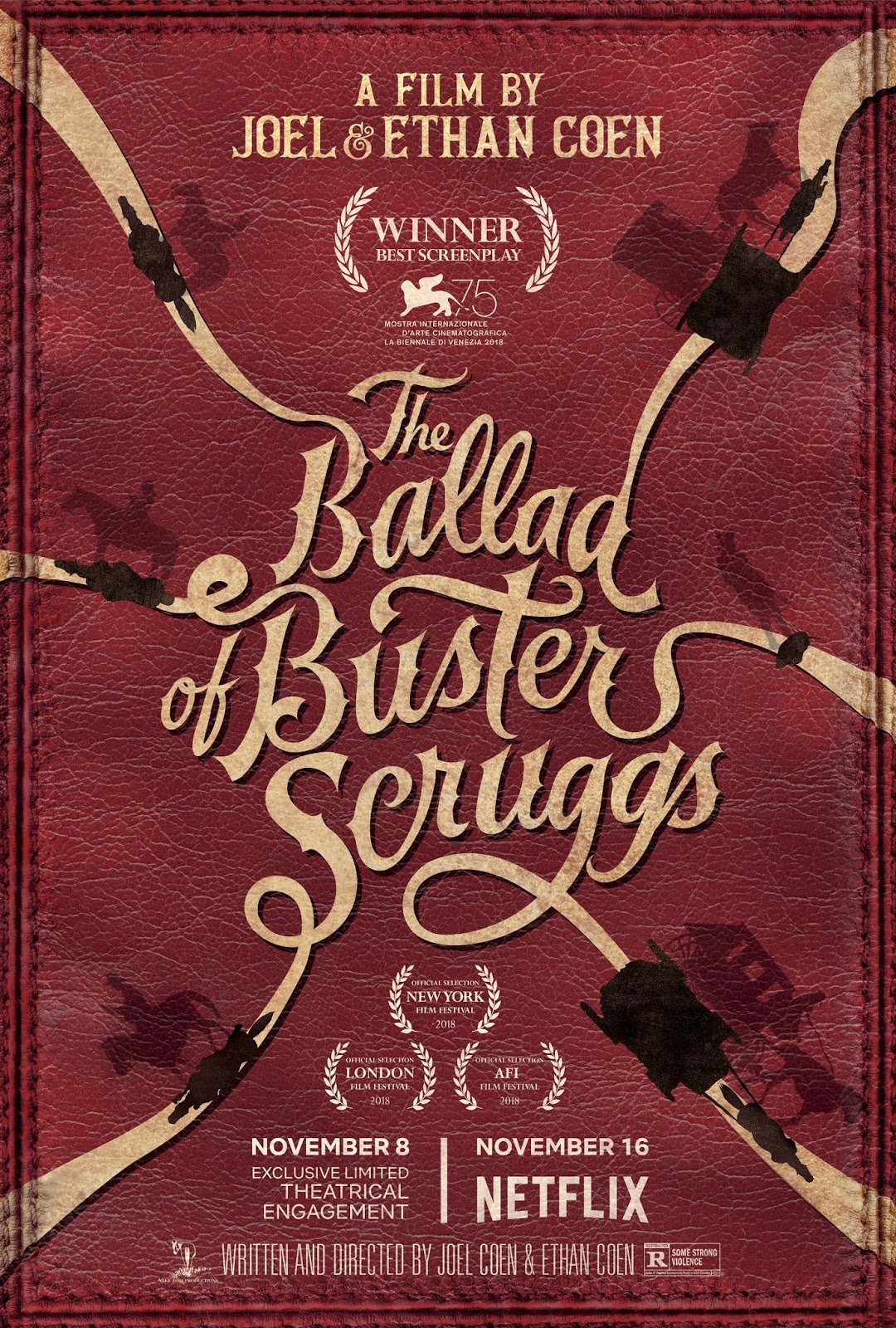
Six stories –all taking place in the ol’ West. Six stories that are morbid to a fault. Six stories that’ll make you laugh, wonder, and feel miserable. Six bullets to a revolver...
Now this is my kind of silly! The ballad of Buster Scruggs is a dark (a bit too dark at times) collection of stories that skilfully manoeuvres between heart-wrenching and hilarity. The best way one could describe this anthology tale is like an ‘updated version of Tales from the Crypt’.
But, where, in the early nineties all the characters in those macabre tales should be unlikable just so the audience wouldn’t mind their inevitable demise much; nowadays times sure have changed.
After movies like Se7en (1995), Fight club (1999), even the Coen’s brothers very own Fargo (1996) and True Grit (2010), audiences have warmed up to the notion of a ‘reasonably good guy’ getting the short end of the stick in drama.
‘Good-guys failing’ is no longer solely reserved for the horror and war genre.
In contemporary drama it is, nowadays, rather common for ‘our’ hero to find him-/herself
in a bigger pickle at the end than when the movie started.
And this is what the Coen brothers use for maximum effect in The ballad of Buster Scruggs. Which, unfortunately is also the biggest critique reviewers can give this movie: ‘We might know that evil triumphing over good is commonplace nowadays but can’t you please give use something? Anything?’
The answer by the Coen brothers is a blunt: ‘No!’
Intermezzo: The hurt factor.
The difference between comedy and melodrama is the ‘amount it hurts’.
Imagine a scene in which a guy is walking down the street and a flowerpot falls on his head (Yes, it’s an old Donald Duck cartoon –and (yes) it serves my purpose). In a melodrama his skull would crack -blood spurting out; he would die on the spot. Then, to ‘use this momentum’ the lover of this poor man would run towards his body and cry her hearth out. In short this scene would probably last for, at least, five minutes.
The same scene: a flowerpot falls and lands on a guy’s head. He is dumbstruck for a moment and, during that time, accidentally pulls a police-officer’s pants down. The officer gets angry and chases the man down the streets.
Now the focus is quickly directed to the pants-less officer, not the ‘horrific event’ that just occurred to the poor protagonist.
Less drama, less ‘hurt’, is the difference between melodrama and comedy, and it is the oldest trick in the book!
More recently Shazam (2019) used this exact same trick on a smaller scale. Here the protagonist meets a handicapped boy. But the boy in question is a loudmouthed joker. He hates his handicap, obviously, but he’d be damned if he is bothered by it. So the boy cracks jokes about his handicap.
By dismissing the (obvious) handicap in a comedic manner the moviemakers are allowed to push some (melo)drama to the boy on another level. In the case of Shazam: The boy doesn’t have any friends.
We, the audience, realize that his handicap (and maybe his way of coping: his loud mouth) might have something to do with it in the backs of our mind. But these possible reasons become background noise to the ‘current’ melodramatic aspect.
In short: you can have a character go through all kinds of (mortal) ordeals and let him brush it off. But when you allow the camera to stay with the event, when you focus, the (melo) drama creeps in.
That’s how you write a (comedy) movie. And that is exactly what the Coen brothers do ‘per excellence’ in The ballad of Buster Scruggs.
Six stories
There as six stories being told in The ballad of Buster Scruggs. And, even though the stories don’t overlap in characters, they do overlap in thematic.
Just to give you a short summary of the stories:
The Ballad of Buster Scruggs
Buster Scruggs is a singing gunslinger who is too perfect for the world he is in. And maybe he’s right.
Near Algodones
A nameless bank robber finds luck and desolation a he ‘pulls the job of a lifetime’.
Meal Ticket
A handicapped entertainer finds his art in danger because the ‘real’ world is creeping in.
It took me a while to recognize the actor – but eyes always stay the same.
All Gold Canyon
A gold-digger finds his gold in the most beautiful of places. Only when he is gone will beauty return –one way or another.
The Gal Who Got Rattled
A woman is on her way to Oregon. But the dog keeps chasing her and she doesn’t have the heart to stop the animal.
The Mortal Remains
Five people on a coach. Destination: the same end.
Each of these stories is as solid as they can be. The ‘hook’ of each story can be surmised in a single sentence. The plot itself might take two more, but not much. The basic ‘tree’ of each story of this movie is simplicity itself. Now it is up to the scriptwriter and the director(s) to but some branches/meat on this tree-or: skeleton.
And this is where, usually, the problems happen.
No perfection Nevada
When writing, direction, or even editing a movie, you are in danger of ‘bloating’ said movie.
Any movie is a story from A to Z. The style or words might be different but still the basis remains. If it is Bollywood, Hollywood or Nollywood movie: each movie, ever made, has a beginning and an end.
It’s the time in-between that’s important.
A movie can spent too much time on things that don’t matter for the (A to Z) story.
One of my favourite ‘bad movies’, for instance, (Haemoglobin -1997) has a pretty long sex-scene that has no purpose whatsoever except for the reconfirmation that the two main characters love each other. The same gist I got five minutes before in the single line of dialogue that said: ‘I love you!’.
So that sex scene was only ‘thrown in’ to please the audience on ‘another level’.
So a movie should be constructed as such that there aren’t a lot of unnecessary scenes (or long scenes) muddling up the main (A to Z) road.
Unfortunately The ballad of Buster Scruggs (like many other movies before and after) fails to do so. But why? This has everything to do with the story the movie is telling at the time in context to the ‘whole’ of the movie.
Too long, but why?
Two of the stories in The ballad of Buster Scruggs tend to overstay its welcome: Meal Ticket and The Gal Who Got Rattled. Both stories are both a bit too long to keep the audience (me) interest/‘invested’. This mainly has to do with the placement of the two episodes in whole of the movie.
By the time these stories appear we’ve already sat through two pretty dark tales so we know that chances are quite high that the next story won’t end happily ever after either.
Keep in mind that the prints shown before each story are a bit of a spoiler.
So a viewer dilemma occurs. On the one hand you want (for example) a ‘love story’, or, a ‘road to riches story’ to reach its end successfully, yet, on the other you know ‘darn well’ that that’s not likely to happen
Knowing what kind of movie you are in prevents said movie to play certain trump cards on you. Each scene needed for the fictional tale of two people falling in love ‘feel unnecessary by context’ because you/the viewer knows that things won’t work out anyway. So why bother?
A great movie might manage to make the audience forget about ‘what kind of movie they are watching’, But, even though The ballad of Buster Scruggs tries (All Gold Canyon) it simply doesn’t manage to play with its audience as it set out to do.
Fixing the fault
A simple fix would be to place either of those two stories at the beginning of the tale. But apart from not being able to call this movie The ballad of Buster Scruggs no-more, one should also realize that neither The meal ticket or The Gal Who Got Rattled are show-openers!
As any entertainer knows you need something mesmerizing to open a show with. And, in The ballad of Buster Scruggs, a singing cowboy might just have to do.
Mentally re-cutting The ballad of Buster Scruggs I would’ve cut-up The meal ticket-story
and used each of the artist’s speeches (watch the movie, you’ll know what I mean) as an interlude to each new tale.
Then, as a final scene I would end the tale as it ended in ‘our current version’.
Leaving the cinema-audience bleak, dark and (above all) shocked.
Still a (gun) blast
Having that said the dialogue is wonderfully written throughout this anthology. Especially noteworthy is the dialogue in The Gal Who Got Rattled. Each scene of her talking to her (possible) lover oozes of innuendo.
Did her brother die from dysentery? I really want to know!
I would be a shame if he didn’t – I’m just talking for the ‘Gamer generation’ here.
But, this being a script movie first (as all the Coen brothers movies basically are) every scene is deliciously written and, above all, deliciously acted. The mad banker (played by a wonderfulStephen Root) in Near Algodones could’ve said the words any kind of way but it was decided to use this particular style.
The same goes for the ‘trapper’ (Chelcie Ross) in The Mortal Remains who has a wonderful, awe-inspiring, monologue that just won’t end.
Just two actors delivering lines. But where the first actor used pitch of voice the second actor mainly used tempo to deliver his lines.
Regardless: still the lines remain.
Combining this with wonderfull shots of the western landscape and you’ve got yourself quite the mesmerizing piece of filmic fiction.
Still, in the end, The ballad of Buster Scruggs might be a bit too bleak in its message to win over anybody else but the Coen-enthusiasts. A shame really. But not something I’m particularly worried about. The brothers have found their own style of storytelling ages ago and are going with it. The movies they make might not appeal to the general audience but are great, well made, movies all the same.
A wife is having an affair. Her husband finds out and wants to kill her for that (and the large inheritance of course). But how does one murder one’s wife – perfectly that is?
I like (almost love) the 1998 movie: a perfect murder. But the reason why is rather more subjective then, let’s say professional. Let’s just count my life down:
Childhood.
My mother is a bed-time storyteller ‘per default’. But even she –with her unlimited supply of fairytales- was, at certain moments in time, at her wits end. So she decided to tell me ‘crime stories’ instead. Especially those stories told by Agatha Christie and Alfred Hitchcock. Me, being six at the time (when does story-time truly end one might ask?) loved it. Particularly the ones in which a criminal gets caught by a simple mistake even six-year-old me could understand.
keep in mind that I was –at the time- desperately trying to steal candy from the candy jar without being caught.
My mother was unbeknownst giving me advice.
Preteen.
I saw Dial ‘M’ for murder (1954) for the first time. I loved every second of it. I loved Grace Kelly for reasons I didn’t fully understand yet. And I loathed Ray Millard because he was so coy about the fact that he was trying to kill his wife.
I also enjoyed seeing Anthony Dawson as the poor smuck set up to be the by-proxy killer. This is the same guy who got himself killed by James Bond in Dr. No (1962). This actor will always be known as the ‘second in command’. I pity him for that; but then again, ‘we’ (the public) will also always love him for that!
What I especially enjoyed at this young age is the amount of planning that goes into committing a perfect crime. A trick that works just as well for planning your homework.
Teenager.
When I was a teenager I won a prize: one year of free movie tickets (two tickets a month). Since I didn’t have anyone to go with me at the time I saw a lot of movies. One of them being a remake of my, personal favourite movie: Dial ‘M’ for murder this time called: A perfect murder (which is, by the way, a ‘perfect’ title).
At the time, I was shocked! This movie was far too American (and overacted).
And this was long before I saw the Christopher Plummer's version (1981). I only saw that (brave attempt of a) movie recently.
Here we have Michael Douglas playing the darker version of Gordon Gekko. Gwyneth Paltrow balancing her way between a coy anti-feminist house-wife and a strong independent woman. And the whole threat for the woman facing a possible death-sentence for a crime she didn’t commit was left way out the door. But most of all; the shock of seeing David Suchet (Mr. Hercule Poirot himself) as a clueless detective broke the movie for me.
At the time I didn’t like the movie much. I enjoyed the fact that Hollywood dared to try another version of a ‘perfect movie’ (more about ‘prefect’ later). But since I didn't like it I moved on.
As I grew up.
As I grew up I started to reject this movie more and more. For the various reasons I’ve hinted at (above). I didn’t see if for at least ten years.
It took time, for me, to accept the fact that A perfect murder isn't a very 'perfect’ movie. But it would be rather dismissive of me to call it a ‘bad’ movie. Or even a ‘bad’ remake for that matter.
Growing older.
It was only when I ‘proudly’ wore the old T-shirt of this movie (another contest I won back then –true story) in a factory-cleaning-job ,that I started to realize the work that’s involved ‘making’ this movie. It all has to do with the simple brilliant poster that featured prominently on my T-shirt. Each time I took the T-shirt out of the wash to get to work I was reminded of the movie. And one day I rewatched it.
The way Michael Douglas posed on the poster (and my T-shirt): brilliant!
Daring the crime.
It is a pretty brave thing to remake a classic. And by the time A perfect murder was made Dial ‘M’ for murder was considered a classic. It was pretty much up there with Psycho (1960) and Vertigo (1958). Not in the ‘top 3’. But important nonetheless!
The original Dial ‘M’ for murder,though, isn’t one of the great ‘Hitchcock-ian’ movies. It’s pretty much a stage play caught on screen (much like Rope [1948] – but with a lot less tricks-up-the-sleeve). The main gimmick of this movie was the 3D-aspect (whatever James Cameron tells you; the technology isn’t that ‘new’). So there is a wonderful shot in this movie which involves (the great) Grace Kelly reaching ‘into the audience’ for her scissors.
The rest of the movie, however, is rather coy. Just people talking.
Hitchcock probably liked the idea of 3D, but he certainly wasn’t going to let it get into the way of good storytelling.
And that’s what Dial ‘M’ for murder really is; It’s a small –stage play- story with some beneficial 3D effects in the tension scenes. But most of all it is a solid tale about a man wanting to murder his wife.
Hitchcock, in this sense, transpired the ‘gimmick of the age’ by giving the movie an unbreakable story that could still work without all the ‘mumbo jumbo’ (of 3D).
So, to be honest, the original wasn't that untouchable to begin with. As long as the remake didn’t hurt the core story too much it would be fine. In this sense the challenge the producers posed to the remaking moviemakers was a simple: “remake Dial ‘M’ for murder. This time without the 3D shenanigans!”
This challenge would’ve been easy, if not for the additional requirement: “make it contemporary!”.
The question of whoever made this choice will never be answered. But one thing is perfectly clear: the choice of the era made all the difference.
Can we make a perfect murder: today?
So now you –the movie maker- are posed with a challenge. What to do? What is the budget? How far can we take this story?
Budget-wise the first choice was made rather easily: since he move would be contemporary the looming death-sentence would be scripted out.
Second; contemporary, means upping the characters. The wife has become more active and (incidentally) so does the husband.
So the wife has to perform an investigation of her own (and destroy he husband along the way). And the husband actually has to kill somebody!
It’s the late 90s we’re talking about. A new ‘view’ on matters as it were. Which also means turning the tables and making the wife’s secret lover the murder-by-proxy.
Getting Old.
Once you realize this, pieces fall into place. The original movie was perfect for its time. The later movie was perfect for ITS time. And, honestly, one shouldn’t compare the two!
So, as I became older I started to enjoy A perfect movie on its own merrit. Meaning: without the baggage of its predecessor, and in this context of the era the movie works like a charm.
The way Gwyneth Palrow uses the gun in the final scene is logical (right for the time) in every sense. The way Michael Douglas’s character bends the truth throughout the movie is flawless and very probable for a ‘high functioning sociopath’ as most bankers are (remember my comment about Gordon Gekko).
For a 1998 movie A perfect murder is quite good! It is the ultimate movie of the year because this is exactly what we wanted back then. But, alas, it got dragged down by its (superior) predecessor.